- Colin Thwaites, who had spent his entire career in mining, died working for Lochaline Quartz Sand Limited.
- Lochaline mine is the only underground quartz sand mine in Europe.
- Mr Thwaites was struck by the blades of a fan which wasn’t sufficiently well-guarded
The operator of Europe’s only quartz sand mine has been fined after an experienced electrician was killed after being struck by the blades of a mine BORA fan.
Colin Thwaites, 61, died on 21 October 2024 while working at Lochaline Quartz Sand Limited’s underground mine on the Morvern Peninsula in the Scottish Highlands.

Mr Thwaites, who had spent his entire career in mining and was the mine’s only time-served electrician, had arrived for his day shift to help restore power following damage caused by Storm Ashleigh. He was working alongside an apprentice to disconnect a communications cable near one of the mine’s BORA fans when the incident occurred. His colleague found him trapped in the fan, having suffered fatal injuries.
HSE investigation findings
The Health and Safety Executive’s (HSE) Mines and Quarries Unit carried out an investigation, with inspectors arriving at the mine the following day. Their findings identified a series of serious failings in how the fan had been modified, commissioned and maintained.
The fan involved had originally formed part of a single in-line assembly unit with a sister fan. In June 2020, the decision was taken at the mine to split this single unit into two separate fans. HSE investigators found that the hazards arising from this modification had not been properly identified or managed. No written risk assessment was produced, no commissioning documents were created, and no records of any management discussion about the separation could be provided.
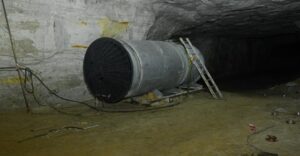
Critically, the splitting of the unit left the rotating parts of the Number 2 fan significantly closer to its intake guard than was safe. The fan blades were just 43mm — less than two inches — from the leading edge of the duct. The relevant guarding standard required a distance of at least 200mm, which could have been achieved through appropriate nose cone or cage-type guarding.
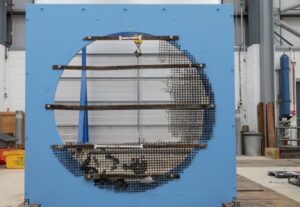
To cover the exposed intake, guards were fabricated on-site from two sheets of metal square lattice mesh, which HSE inspectors determined was poorly designed. The metal bracing straps were fitted on the outside of the mesh panels rather than the inside, providing no additional structural strength. The exhaust end of the fan remained entirely unguarded.
When inspectors examined the fan the day after the incident, the intake guard was found to be in a seriously degraded condition. Significant areas of mesh were missing, particularly around the fan’s impeller hub. Wire and mesh pieces recovered from the floor showed heavy corrosion on their broken ends, indicating they had been in that condition for some time — not freshly broken during the incident. Further pieces of mesh had been ejected through the fan during the incident itself. Had the guard been properly designed and maintained, it is likely it would have prevented the fatal incident.
Compounding these failures, the two fans had not been listed on the mine’s Mechanical Asset Register. No inspection checklists or maintenance records for them could be provided. While electrical inspections had been recorded, the degraded condition of the inlet guard had not been identified during those processes.
HSE took immediate and appropriate enforcement action against the company, who then engaged a specialist mining consultancy to achieve compliance.
Lochlaine Quartz Sand Limited, of European Technical Centre, Hall Lane, Lathom, in Ormskirk, Lancashire, pleaded guilty to breaching Section 2(1) and Section 33(1)(a) of the Health and Safety at Work etc. Act 1974. The company was fined £150,000 and told to pay a Victim Surcharge of £11,250 at Inverness Sheriff Court on 16 June 2026.
Kevin Wilson, HSE’s chief inspector of mines and quarries, said:
“This was a tragic and entirely preventable death.
“Colin Thwaites was a highly experienced mining professional with decades of service. He should have gone home to his family that day.
“Our investigation found that when the fan was modified, the risks were not identified. The guarding that was put in place was inadequate from the outset, and its deteriorating condition went unnoticed because there was no proper maintenance regime in place.
“Mine operators have clear legal duties to ensure equipment is safely commissioned and maintained. Where those duties are not met, the consequences can be fatal.”
Further information:
- The Health and Safety Executive (HSE) is Britain’s national regulator for workplace health and safety. We are dedicated to protecting people and places, and helping everyone lead safer and healthier lives.
- More information about the legislation referred to in this case is available.
- Further details on the latest HSE news releases is available.
- HSE does not pass sentences, set guidelines or collect any fines imposed. Relevant sentencing guidelines must be followed unless the court is satisfied that it would be contrary to the interests of justice to do so. The sentencing guidelines for health and safety offences in Scotland can be found here.