Press release

Fine for company after man seriously injured at wind farm

A wind farm management services company has been fined £80,000 after a worker was seriously injured by an electrical flashover.

Natural Power Services Limited had sent the then 38-year-old to carry out maintenance work in an electrical substation within the Tom Nan Clach Wind Farm, near Inverness on 23rd June 2020. His injuries resulted in him sustained life-changing injuries that have required multiple surgeries.

An investigation by the Health and Safety Executive (HSE) found that the incident happened following a departure from the prepared switching programme. This meant work was allowed to be carried out on one of the two electrical cabinets while the other remained live, allowing part of the electrical system to be energised during the maintenance work.

The HSE investigation found that had the initial switching programme prepared by Natural Power Services Limited been correctly followed, the incident would not have occurred. The company did not have a suitable system or process in place to check or review switching programmes to ensure that the procedures were correctly observed at all times, or to approve any changes to the initial switching programmes.

Free guidance for employers is available on the HSE website, hse.gov.uk, about electrical safety and managing health and safety.

Natural Power Services Limited pleaded guilty to breaching Sections 3(1) and Section 33(1)(a) of the Health and Safety at Work etc. Act 1974. The company was fined £80,000 at Inverness Sheriff Court on 25 November 2025.

Speaking after the hearing, an HSE spokesperson said: “This was a wholly avoidable incident caused by the failure of the company to implement a safe system of work.

“The company should have ensured there was a suitably rigorous process for checking and reviewing the work. This would have ensured those doing the work were adhering to switching programmes in a manner that was suitable and safe.

This would have been a reasonably practicable measure to address the risks arising from the subsequent introduction of additional parallel works that might interfere with the previously planned switching programme.”


Further information:

  1. The Health and Safety Executive (HSE) is Britain’s national regulator for workplace health and safety. We are dedicated to protecting people and places, and helping everyone lead safer and healthier lives.
  2. More information about the legislation referred to in this case is available.
  3. Further details on the latest HSE news releases is available.
  4. HSE guidance about electrical safety and managing health and safety is available.
  5. HSE does not pass sentences, set guidelines or collect any fines imposed. Relevant sentencing guidelines must be followed unless the court is satisfied that it would be contrary to the interests of justice to do so.  The sentencing guidelines for health and safety offences can be found here.
Fine for care home company after failures resulted in resident’s death

A care home company has been fined over £1.8 million after a resident choked on a piece of food while consuming her evening meal alone in her room.

Elizabeth Campbell (known as Peggy) was a 96-year-old resident of Cradlehall Care Home in Inverness. She was on a specialist diet of soft, moist and bite-sized food and her care plan stated that she should be closely supervised when eating and drinking.

The Court heard that on 11 June 2022, the unit where Peggy resided was staffed by two agency carers who were responsible for twelve residents. At about 5.45pm, Peggy was served a meal of macaroni and chips while sitting up in bed.

One of the carers left to get a drink to accompany her meal but was then forced to deal with urgent issues with two other residents which required her to call for assistance from another unit. As a result of this disruption the resident was left on her own for up to 20 minutes by the time the carer returned to her room with the drink.

The carer raised the alarm, and other staff came to assist. A paramedic arrived shortly afterwards and the woman was pronounced dead.

An investigation by the Health and Safety Executive (HSE) concluded that Peggy’s death was caused by the fact the company had failed to ensure that all those working in the home had access to and were familiar with the care plans of its residents and that crucially Peggy had been left unsupervised while eating.  Following the investigation, HSE took action against the company, with improvements later being made to ensure there was a ‘skills mix’ during shifts – ensuring any agency staff were always assisted by regular employees, who were more aware of the needs of the home’s residents.

HC-One Limited, who run the care home, pleaded guilty to failings under the Health and Safety at Work etc Act 1974. The company was fined £1.8 million at Inverness Sheriff Court on 20 October 2025.

HSE inspector Michelle Gillies said: “This incident was completely preventable had the company taken steps to ensure all of those working at the home knew about the needs of its residents.

“While no blame has been placed on any individual, the company’s failures in this case caused Peggy’s death.

“Sadly, this isn’t the first resident choking case HSE has had to investigate and we implore care homes companies to do all they can to protect their residents.

“Our thoughts remain with her family.”


Further information:

  1. The Health and Safety Executive (HSE) is Britain’s national regulator for workplace health and safety. We are dedicated to protecting people and places, and helping everyone lead safer and healthier lives.
  2. More information about the legislation referred to in this case is available.
  3. Further details on the latest HSE news releases is available.
  4. HSE does not pass sentences, set guidelines or collect any fines imposed. Relevant sentencing guidelines must be followed unless the court is satisfied that it would be contrary to the interests of justice to do so.  The sentencing guidelines for health and safety offences in Scotland can be found here.

Global glass bottle maker fined £600k after worker injured

A global glass bottle manufacturer has been fined £600,000 after a worker was burnt by molten glass and hot water spilling into his cab.

O-I Glass Limited pleaded guilty to one charge following the incident at its Glasshouse Loan site in Alloa on 3 February 2024.

A 32-year-old man suffered scald burns to 8 percent of his body but has since been able to make a full recovery.

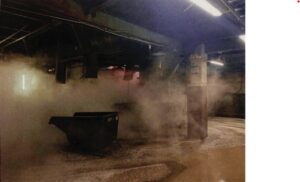
The basement of the site and the skips being used to collect waste product

The company, which employs around 500 people at the site, continually operates furnaces that are used to smelt raw materials, from which glass bottles are manufactured. The furnaces and production lines are located on the floor above two glass reject basements, which house a number of large, moveable skips. It is into these skips that molten or formed glass is rejected, via chutes, during the production process. Coolant water runs down each chute with the rejected molten or formed glass, which in turn generates very hot water and large amounts of steam.

Due to the continuous nature of the operation, the skips would quickly fill and sometimes reject material and water would spill from the skips onto the basement floors. Employees working in these basements used shovel loaders to clear this spilled material from the floors, which was then emptied into other skips.

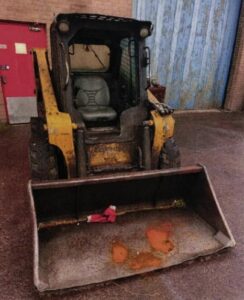
On the day in question, the worker had been operating a shovel loader, clearing the waste molten glass and hot water from the basement floor. However, there was no protective door on the cab of the vehicle, so some of that material spilled from the bucket onto him.

The shovel loader with missing protective door

When it was first provided for use, the loader was fitted with a protective door incorporating a glass window, in front of the cab. However, an investigation by the Health and Safety Executive (HSE) established that the protective door had been missing since March 2022. It had been removed from the vehicle after being damaged, and although this was reported to the site engineer at the time, no action was taken to replace it. In the almost two years that went by, other operatives had reported being struck or having footwear burnt by molten glass falling into the cab.

HSE guidance, specifically the publication “A guide to workplace transport safety – HSE (HSG136) paragraph 219 & 220: states that ‘vehicles should be fitted with additional protection for those working ….in an inhospitable working environment…. where there is a risk of being struck by falling objects, the vehicle should be fitted with a falling-object protective structure (FOPS)’ and Safe use of work equipment – HSE (Approved Code of Practice to the Provision and Use of Work Equipment Regulations 1998 (PUWER))

Following the incident, the company removed the vehicle from service, and it didn’t return until June 2024, after being fitted with a steel front door, incorporating a glass window with protective wire mesh.

O-I Glass Limited, of Edinburgh Way, Harlow, Essex, pleaded guilty to Regulation 5 (1) of The Provision and Use of Work Equipment Regulations 1998 and section 33(1) of Health and Safety at Work etc Act 1974 for failing to maintain the vehicle in an efficient state, in efficient working order and in good repair. The company was fined £600,000 at Stirling Sheriff Court on 23 September 2025.

HSE inspector Kathy Gostick said: “This was an avoidable ordeal for a young worker. It is sheer luck he has been able to recover from his serious injuries.

“This company’s employees worked in this environment with a safety critical part of the loader missing for a period of almost two years.

“Although the protective front door had been removed and reported to the on-site engineer, drivers had continued to work and operate the loader with it missing.

“Some operatives even described being struck or having footwear burnt by molten glass falling into the cab as a result.

“When work equipment is being selected, its suitability for the environment it is going to be used in must be risk assessed. In this case the protective door was not suitable to protect against impacts from hot and molten glass and therefore was often broken and in the end never replaced. Had an appropriate door been selected and maintained in place this accident would not have occurred.”


Notes to Editors

  1. The Health and Safety Executive (HSE) is Britain’s national regulator for workplace health and safety. We are dedicated to protecting people and places, and helping everyone lead safer and healthier lives.
  2. More information about the legislation referred to in this case is available.
  3. Further details on the latest HSE news releases is available.
  4. HSE does not pass sentences, set guidelines or collect any fines imposed. Relevant sentencing guidelines must be followed unless the court is satisfied that it would be contrary to the interests of justice to do so.  The sentencing guidelines for health and safety offences in Scotland can be found here.

Council fined after failures led to care home death

A local authority has been fined after the death of a patient who went missing from a care home on the Isle of Barra.

Western Isles Council pled guilty to a charge under the Health and Safety at Work Act following the death of a 69-year-old man at St Brendan’s Care Home in Castlebay.

Allan MacLeod, who had been diagnosed with Dementia, had been a resident at the home – one of five operated by the council throughout the Western Isles – for around six months at the time of his death. In the early hours of 9 March 2024, he had been able to leave his bedroom without the knowledge of staff and was only found around four hours after going missing. He died a short time later in hospital.

Mr MacLeod had been placed in the home in October 2023 to allow him to be nearer a relative who stayed on Barra. In his first month at the home, staff observed him and determined patterns in his behaviour and how they could best assist him. He was able to go on regular road trips around the island with his family.

On 8 March, having been settled in bed around 9pm, hourly checks were carried out to ensure his wellbeing, but at 2am on 9 March, his bed was unoccupied, and he could not be accounted for after a search of the home.

To avoid being observed by staff, he had exited the home via the only door that was not alarmed and was ten metres from his bedroom. Police Scotland were alerted and a search initiated.

Local Coastguard, RNLI and firefighters were called out to assist in the search and at around 6am, the Coastguard helicopter detected a heat signature near the home on the patio of a residential property.

Mr MacLeod was found with facial injuries consistent with falling. He was transferred to hospital, but despite the efforts of medical staff, he died an hour later.

An investigation by the Health and Safety Executive (HSE) determined that he had made several previous attempts to leave the home. Any measures that staff had taken to mitigate this, by fitting an electronic tag to his clothing that indicated his whereabouts had been defeated by Mr Macleod having removed it.

A risk assessment carried out in December 2023 indicated that Mr MacLeod would remove a tag if he located it, therefore staff required to be vigilant to this behaviour. It was only after his death that the home introduced a regime of half hourly checks on residents. Arrangements had already been made to install keypad entry systems on all doors, but this work had not been completed before Mr MacLeod’s death.

Western Isles Council, of Sandwick Road, Stornoway, pleaded guilty to breaching Sections 31 and Section 33(1)(a) of the Health and Safety at Work etc. Act 1974. The council was fined £80,000 at Lochmaddy Sheriff Court on 6 August 2025.

HSE inspector Ashley Fallis said: “This was a tragic and preventable death.

“The council should have made sure the home had stronger measures in place with Mr MacLeod’s risks already known and assessed.

“Although changes have since been made, they came too late to prevent his death.”


Further information:

  1. The Health and Safety Executive (HSE) is Britain’s national regulator for workplace health and safety. We are dedicated to protecting people and places, and helping everyone lead safer and healthier lives.
  2. More information about the legislation referred to in this case is available.
  3. Further details on the latest HSE news releases is available.
  4. HSE does not pass sentences, set guidelines or collect any fines imposed. Relevant sentencing guidelines must be followed unless the court is satisfied that it would be contrary to the interests of justice to do so.  The sentencing guidelines for health and safety offences in Scotland can be found here.

Demolition firm fined after worker seriously injured in fall from height

A demolition company has been fined after a worker fell six metres through a roof opening during a demolition project, suffering serious injuries.

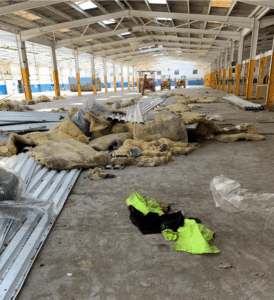
Lawrie (Demolition) Limited had been appointed as the principal contractor to carry out the demolition of a vacant warehouse in Aberdeen.

Warehouse in question

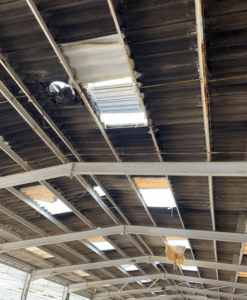
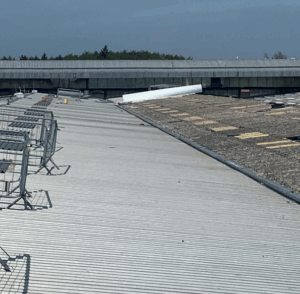
On 25 May 2023, 42-year-old Sylwester Zdunczyk was working with a team on the warehouse roof, removing aluminium over-sheeting. The sheets were being carried to pre-cut holes in the roof from where they were dropped to the ground floor. These holes were guarded by steel crowd control barriers secured together with plastic tie wraps – but they were not attached to the roof surface. No other fall prevention measures were in place.

While helping to carry a sheet backwards near one of the holes, Mr Zdunczyk lost his footing. The weight of the sheet and his own bodyweight caused the unattached barriers to shift, exposing the edge of the opening and creating a gap. He fell approximately six metres to the concrete floor below.

the worker fell from this roof

Mr Zdunczyk sustained a fractured pelvis and two broken ribs. He was unable to work for six months after being discharged from hospital and has not fully recovered. Previously fit and active, he can no longer run, cycle or play football and now requires pain medication.

An investigation by the Health and Safety Executive (HSE) found that Lawrie (Demolition) Limited failed to properly plan, supervise, and carry out the work at height safely. Workers were sent onto the roof without sufficient instruction, training or supervision. The company also failed to put adequate fall protection measures in place.

Working at height remains one of the leading causes of workplace injury and death and HSE has detailed guidance on working safely at height.

the warehouse

Lawrie (Demolition) Limited, of Rigifa, Cove, Aberdeen, pleaded guilty to breaching Regulation 4 of the Work at Height Regulations 2005 and Section 33(1)(c) of the Health and Safety at Work etc Act 1974. The company was fined £40,562.50 at Aberdeen Sheriff Court on 12 June 2025.

HSE inspector Muhammad Umair Tanvir said:
“This incident could have been avoided by simply implementing appropriate control measures and safe working practices.

“Falls from height remain the leading cause of fatalities and serious injuries in UK workplaces. In 2023/24, 50 workers died following a fall from height – the highest cause of workplace fatalities. This trend has remained consistent over recent years.”

Further information:

  1. The Health and Safety Executive (HSE) is Britain’s national regulator for workplace health and safety. We are dedicated to protecting people and places, and helping everyone lead safer and healthier lives.
  2. More information about the legislation referred to in this case is available.
  3. Further details on the latest HSE news releases is available.
  4. HSE does not pass sentences, set guidelines or collect any fines imposed. Relevant sentencing guidelines must be followed unless the court is satisfied that it would be contrary to the interests of justice to do so.  The sentencing guidelines for health and safety offences in Scotland can be found here.

Edinburgh Airport fined after pensioner fell from ambulift

The owner of Edinburgh Airport has been fined £80,000 after a pensioner fell from an ambulift on his return from holiday.

Following the fall, James Young was admitted to hospital, but died more than a week later from his injuries .

The 81-year-old had just landed at the airport after holidaying on the Greek island of Rhodes with his wife Anne, when the incident happened on 28 November 2023.

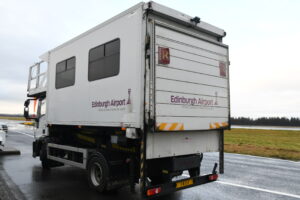
The Ambulift used by Mr Young and his wife

Mr Young and his wife, who has mobility issues, had been waiting for one of the airport’s ambulifts to assist them disembarking the aircraft shortly after 4pm. The couple had been two of six people requiring the assistance of the ambulift following the flight.

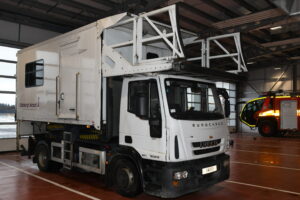
Ambulifts are a specially designed vehicle to assist passengers with reduced mobility. Edinburgh airport has several such vehicles which are owned, maintained and operated by the airport and driven by its employees.

Passengers who cannot embark or disembark using the aircraft steps can use an ambulift cabin, which is capable of being elevated to the level of the aircraft’s door and lowered to the chassis of the vehicle. At the rear of the vehicle, a tail lift platform is then deployed to the same level as the floor level of the passenger compartment.

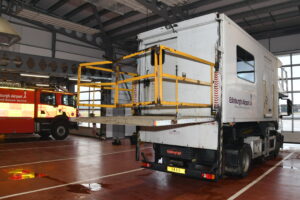
The locking mechanism on the safety rail was misaligned

Passengers then exit the compartment onto the tail lift, which unlike the compartment, is not enclosed, but has safety side rails and a rear gate around its perimeter. Once secure on the tail lift, it is lowered to ground level, allowing its users to move on to the tarmac step free.

Mr Young attempted to pass a piece of hand luggage to a worker on the ground whilst the tail lift had not yet been lowered. It is believed he leant  against the safety rail, which swung open causing him to fall approximately five feet to the ground below.

He was assisted to his feet and helped into a wheelchair and although he wasn’t thought to have sustained serious injury at time, he was taken to hospital. When examined at Edinburgh Royal Infirmary, it was found Mr Young had sustained  serious injuries and he subsequently died on 7 December as a result of these injuries.

As a result of the incident, Edinburgh Airport Limited submitted a RIDDOR to the Health and Safety Executive (HSE) and an investigation was carried out. That found that when it was raised from the ground, the locking mechanism on the tail lift’s safety rail was misaligned, meaning it could potentially open outwards if pressure was applied to it. When the safety rail moved outwards from the lifting platform an open edge was created and it was through this that Mr Young fell.

The ambulift that was used on the day in question

The Provision and Use of Work Equipment Regulations 1998 require every employer to ensure that work equipment is maintained in an efficient state, in efficient working order and in good repair. Equipment must be maintained so that its performance does not deteriorate to the extent that people are put at risk. HSE guidance is available on the maintenance of work equipment.

Edinburgh Airport Limited pleaded guilty to breaching Regulation 5(1) of the Provision and Use of Work Equipment Regulations 1998 and Section 33(1)(c) of the Health and Safety at Work etc. Act 1974. The company was fined £80,000 at Edinburgh Sheriff Court on 10 June 2025.

HSE inspector Jurate Gruzaite, said: “Edinburgh Airport Limited had a duty to ensure all of its work equipment was maintained in an efficient state and in working order. The company failed in this duty and had a role in a family tragedy that unfolded the moment Mr and Mrs Young returned from holiday.

“It is clear that the fault on the ambulift had been in place before Mr Young fell from the platform.

“We can only hope this tragic incident is one the industry can learn from.”


Further information:

  1. The Health and Safety Executive (HSE) is Britain’s national regulator for workplace health and safety. We are dedicated to protecting people and places, and helping everyone lead safer and healthier lives.
  2. More information about the legislation referred to in this case is available.
  3. Further details on the latest HSE news releases is available.
  4. HSE does not pass sentences, set guidelines or collect any fines imposed. Relevant sentencing guidelines must be followed unless the court is satisfied that it would be contrary to the interests of justice to do so.  The sentencing guidelines for health and safety offences in Scotland can be found here.

Food company fined £360,000 after worker loses consciousness

A company in Fife which grows and prepares vegetables has been fined £360,000 after a worker was dragged into a machine and lost consciousness.

Remigiusz Cyrek, a hygiene operative at Kettle Produce Limited, was undertaking a routine clean of a machine that makes carrot batons on 22 June 2018. The 37-year-old was trapped by a giant roller after being dragged into the machine at the company’s premises at Orkie Farm, in Freuchie.

Mr Cyrek had been cleaning part of the conveying machinery which had not been isolated from the power supply. The hood of his waterproof jacket became entangled in a moving power driven roller, causing it to tighten around his neck and resulting in him losing consciousness. The incident left the Polish national unable to work for six months afterwards.

An investigation by the Health and Safety Executive (HSE) found that Kettle Produce Limited had failed to provide a safe system of work for employees who were cleaning the machinery.  A safe system of work should ensure that cleaning activities are not carried out whilst the machinery was moving, and that all parts were isolated and locked-off  from the power supply.

HSE guidance on working safely with machinery is available.

Kettle Produce Limited, of Balmalcolm Farm, Cupar, Fife, pleaded guilty to breach Section 2(1) and Section 33(1)(a) of the Health and Safety at Work etc Act 1974. The company was fined £360,000 at Dundee Sheriff Court on 23 November 2023.

HSE inspector Kerry Cringan said: “This incident could so easily have been avoided by simply carrying out correct control measures and safe working practices.

“While cleaning is an essential part of food processing, hygiene operatives should not be exposed to risks from unguarded moving parts.

“Companies should be aware that we will not hesitate to take appropriate enforcement action against those that fall below the required standards.”


Notes to Editors:

  1. The Health and Safety Executive (HSE) is Britain’s national regulator for workplace health and safety. We prevent work-related death, injury and ill health through regulatory actions that range from influencing behaviours across whole industry sectors through to targeted interventions on individual businesses. These activities are supported by globally recognised scientific expertise.
  2. More information about the legislation referred to in this case is available.
  3. Further details on the latest HSE news releases is available.
  4. Guidance on working safely with machinery is available.