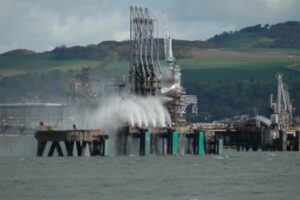
- The incident occurred in the early hours of 1 November 2018 at Braefoot Bay Marine Terminal, Firth of Forth, Fife.
- Flammable vapour cloud have resulted in a catastrophic explosion if ignited.
- Vladimir Volkov was treated at hospital and subsequently repatriated to Russia, where he received further treatment. He is understood to have returned to work.
A ship’s engineer suffered serious cold burns after Shell UK’s flawed safety procedures led to a violent release of liquid propane during loading operations at a Firth of Forth marine terminal, a Health and Safety Executive investigation has found.
Vladimir Volkov, a gas engineer aboard the tanker MV Symi, sustained cold burns to 10–13% of his body surface after liquid propane was released without warning at Shell’s Braefoot Bay Marine Terminal near Dalgety Bay, Fife, in the early hours of 1 November 2018.

The incident created a rapidly expanding flammable vapour cloud that enveloped workers on both the ship’s deck and the adjacent jetty. While the crown agreed the probability of ignition was between 1-2 per cent, the results of such an ignition could have proven catastrophic.
HSE’s investigation was carried out by inspectors and specialists in its Chemical, Explosives, and Microbiological Hazards division – reflecting the large quantities of dangerous substances handled at the site.
How it happened
The release was triggered when a Shell technician accidentally pressed a button on a remote-control handset, causing a loading arm quick release coupling to disconnect from the ship’s manifold before the arm had been fully cleared of propane. An estimated 250–300 kilograms of liquid propane was released at pressure in a matter of seconds.
HSE investigators established that Shell’s own operating procedure — which required a critical safety mechanism known as an emergency release coupling to be disarmed before the arm had been fully purged and drained — directly contradicted the guidance provided by the loading arm manufacturer. It also contradicted procedures prepared by a third party involved in the installation of the equipment.
The failings Shell should have caught
The HSE investigation identified two significant underlying failings.
First, Shell’s system of work was unsafe. The operating procedure in place at the time required workers to disarm the emergency release coupling too early in the disconnect sequence — before the loading arm was fully cleared of product. This left a dangerous window in which an accidental button press could, and did, cause a sudden propane release.
Second, Shell’s management of change process was wholly inadequate. When the company replaced all four of its marine loading arms in 2018 — upgrading to new equipment from a different manufacturer that operated differently, including via wireless remote control and with a quick release coupling — it treated the project as a straightforward “like for like replacement.” It was not.
Shell failed to conduct a full risk assessment of the new loading operation. The new arms introduced a remote-control handset with exposed coupling buttons on its side, a feature that had not existed on the previous equipment. No consideration was given to basic protective measures such as fitting interlocks to prevent the coupling from opening while propane was still present, or simply shrouding the buttons to prevent accidental activation.
Following its own post-incident review — prompted by an Improvement Notice served by HSE — Shell identified that a coupling interlock was both technically feasible and reasonably practicable. That system could have prevented the incident entirely.
The broader risk
The vapour cloud produced by the release extended the full length of the ship and across the jetty, reaching down to the surface of the sea. It was registered by gas detection monitors 20 metres away. Propane vapour is heavier than air, highly flammable, and capable of travelling significant distances to find an ignition source. Had the cloud ignited, those in the immediate vicinity would have faced significant risk to their lives.
Shell UK Limited pleaded guilty to breaching The Control of Major Accident Hazards Regulations 2015, Regulation 5(1) and the Health and Safety at Work etc. Act 1974, Section 33(1)(c). The company was fined £450,000 at Kirkcaldy Sheriff Court on 26 May 2026.
HSE principal specialist inspector Euan Ross said:
“Shell had adapted procedures from its old equipment and applied them to a new and fundamentally different system, without carrying out adequate safety checks.
“While the injuries sustained were serious enough, this could have been a far more catastrophic event.
“We will not hesitate to take action against companies which fail to do all that they should to keep people safe.”
Further information:
- The Health and Safety Executive (HSE) is Britain’s national regulator for workplace health and safety. We are dedicated to protecting people and places, and helping everyone lead safer and healthier lives.
- More information about the legislation referred to in this case is available.
- Further details on the latest HSE news releases is available.
- HSE does not pass sentences, set guidelines or collect any fines imposed. Relevant sentencing guidelines must be followed unless the court is satisfied that it would be contrary to the interests of justice to do so. The sentencing guidelines for health and safety offences in Scotland can be found here.