- 700-tonne tank containing calcium chloride was more than 30 years old and corrosion was first identified a decade before incident.
- 62-year-old left with life-changing injuries and not been able to work since.
- Peterhead base handles thousands of ship movements each year.
A company has been fined £350,000 after the catastrophic collapse of a storage tank at its Peterhead premises which left a self-employed worker with life-changing injuries.
The Health and Safety Executive (HSE) investigated the incident, which occurred on 21 June 2023 at Tetra Technologies UK Limited’s offshore supply base. The base handles around two thousand ship movements per year, supplying North Sea oil and gas installations with deck cargos and quantities of fluids.
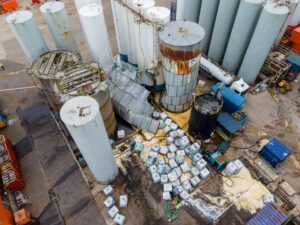
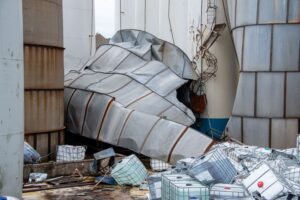
Philip Moir, a 62-year-old self-employed rope access technician, was on site conducting surveys of storage tanks when Tank 7 — a bolted steel tank holding approximately 480,776 litres of calcium chloride solution weighing around 700 tonnes — catastrophically ruptured without warning.
Mr Moir was almost immediately immersed to chest height in the released fluid. He was subsequently found slumped over the wheel of a nearby cherry picker, which itself, along with a Ford Transit pickup, a small skip and the cherry picker — weighing twelve and a half tonnes — had all been displaced by the force of the escaping fluid.
Mr Moir sustained a double fracture of his spine and pelvis, lacerated liver, punctured lung, multiple rib fractures, fractured sternum, a fractured wrist, and extensive chemical burns requiring skin grafts. He has not worked since the incident and is unable to climb ladders or work at height, injuries described as life-changing.
HSE’s investigation, conducted by both regulatory and specialist inspectors, identified that the structural failure occurred around halfway up the tank shell, where the third row of plates split vertically along a bolted seam. Approximately 4.5mm of the original 5.5mm steel plate had been lost through corrosion over time, leaving just 1mm of steel unable to withstand the outward forces of the fluid within. Investigators found that the loss of any protective coating had left the steel surfaces exposed to aggressive coastal air, accelerating external degradation. The density of calcium chloride — more than one third denser than water — further increased the forces applied to the already weakened structure.
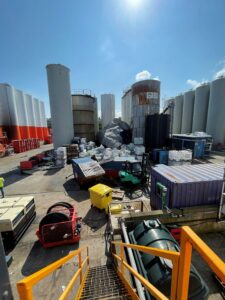
The tank was more than 30 years old and the manufacturer’s maintenance manual required six-monthly checks of seams and bolts, and annual external inspections for corrosion. An inspection in 2013 had already identified extensive outer surface corrosion over the lower section of the tank and corrosion at bolted connections, yet no remedial work was carried out on Tank 7. The company was unable to provide evidence of any regular inspection regime being followed in the years that followed.
On the morning of the incident, Tank 7 had been filled to capacity — a step taken to create space at the company’s Aberdeen premises — and failed less than thirty minutes after the final load was pumped in. HSE concluded that the failure of the tank was wholly foreseeable and preventable.
Following the incident, the company removed all bolted tanks from its sites and closed its Peterhead operation, relocating to its Aberdeen premises.
Tetra Technologies UK Limited of One Fleet Place, London, pleaded guilty to breaches under sections 3(1) and 33(1)(a) of the Health and Safety at Work Act etc. 1974. The company was fined £350,000 at Peterhead Sheriff Court on 13 May 2026.
HSE Inspector Mark Carroll said:
“This was a completely preventable incident.
“The corrosion that caused this tank to fail had been identified a decade before it collapsed, yet no remedial action was taken and there is no evidence that the required inspection regime was ever consistently followed.
“A worker has been left with life-changing injuries as a direct consequence of those failures.
“Companies have a legal duty to maintain equipment in an efficient state and good repair, and HSE will not hesitate to take action where that duty is not met.”
Further information.
- The Health and Safety Executive (HSE) is Britain’s national regulator for workplace health and safety. We are dedicated to protecting people and places, and helping everyone lead safer and healthier lives.
- More information about the legislation referred to in this case is available.
- Further details on the latest HSE news releases is available.
- HSE does not pass sentences, set guidelines or collect any fines imposed. Relevant sentencing guidelines must be followed unless the court is satisfied that it would be contrary to the interests of justice to do so. The sentencing guidelines for health and safety offences in Scotland can be found here.