Press release

Grounds maintenance company fined after employee killed operating ride-on lawnmower

A grounds maintenance company has been fined after an employee was killed while operating a ride-on lawnmower near Ripon.
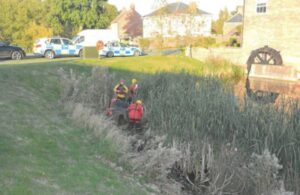
the lawnmower involved

Kamil Grygieniec, 23, from Northallerton, was cutting grass around a village pond in North Stainley on 8 October 2021 when the ride-on mower he was operating descended a steep incline and ended up in it.

The mower was being used without a safety-critical roll-over protection system (ROPS) fitted.

An investigation by the Health and Safety Executive (HSE) found that MHS Countryside Management Limited had failed to carry out a suitable and sufficient site-specific risk assessment for the work being undertaken.

The investigation also established that the mower’s roll-over protection system (ROPS) had been removed at some point prior to the work taking place. ROPS are designed to protect operators in the event of a machine overturning and are a critical safety feature when working on uneven or sloping ground.
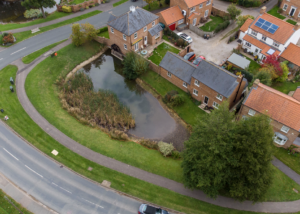
where the incident took place

Suitable risk assessment is essential when operating ride-on machinery, particularly while doing so on slopes or near water. Employers must ensure equipment is appropriate for the terrain and fitted with necessary safety features to protect operators. Find out more on our website here Risk assessment: Template and examples – HSE.

MHS Countryside Management Limited, of Bishop Auckland, pleaded guilty to breaching Section 2(1) of the Health and Safety at Work etc. Act 1974. The company was fined £27,000 and ordered to pay £11,166 in costs at York Magistrates’ Court on the 17 February 2026.

Family tributes

Kamil’s mother and father said:

“The pain I feel every day since that tragedy is unimaginable, I do not wish that on anybody. That day I lost part of me.

“I will never be able to hug him, tell him how much I love him. I will never receive flowers from him, will never meet him wife or his children. Kamil was my physical and mental support.

“That day was his last day at that workplace and it happened to be the last day of his short life.”

“I don’t know what life holds for the future for me, but what I am certain of is it will not be as full or as happy now that Kamil has gone from our lives.

“What makes it even worse, I believe his death could have been prevented and should never have happened.”

After the hearing, HSE Inspector Darian Dundas said:

“This is a profoundly tragic case which is made all the more harrowing because the safety feature designed to prevent incidents like this had been removed from the lawnmower – leading to the fatal turn of events which has robbed a family of their loved one.

“The completion of a suitable and sufficient site-specific risk assessment is vital before undertaking work activities and ensures appropriate action can be taken to eliminate hazards or, where this is not possible, to properly control the risks.

“In this case, the failure to assess the risks and ensure suitable safety measures were in place resulted in a tragic and entirely avoidable loss of life.”

This prosecution was brought by HSE enforcement lawyer Iain Jordan and supported by paralegal officer Stephen Grabe.

Further information:

  1. The Health and Safety Executive (HSE) is Britain’s national regulator for workplace health and safety. We are dedicated to protecting people and places, and helping everyone lead safer and healthier lives.
  2. More information about the legislation referred to in this case is available.
  3. Further details on the latest HSE news releases is available.
  4. Relevant guidance can be found here Risk assessment: Template and examples – HSE
  5. HSE does not pass sentences, set guidelines or collect any fines imposed. Relevant sentencing guidelines must be followed unless the court is satisfied that it would be contrary to the interests of justice to do so.  The sentencing guidelines for health and safety offences can be found here.
Animal feed manufacturer fined £500,000 after worker seriously injured

A Yorkshire animal feed manufacturer has been fined £500,000 after a worker lost part of his foot when it was entangled in machinery.

William Thompson (York) Limited pleaded guilty after failing to prevent access to a rotating auger – a tool consisting of a central shaft with a blade wrapped around it – which is designed to transport excess feed away from a press.

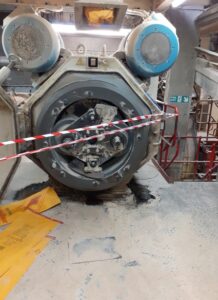
The pressing machine at the factory

The 41-year-old had been working as a supervisor at the company’s Jubilee Mill site in York on 14 November 2023. At the time of the incident, the man had been trying to resolve a maintenance issue with the machinery. However, he was able to open the press while its parts remained in operation at significant speed. His foot became entangled in the rotating auger and he sustained injuries so serious he remained in hospital for a period of six weeks.

An investigation by the Health and Safety Executive (HSE) found that William Thompson (York) Limited failed to prevent access to dangerous parts of the machinery and also to carry out a suitable risk assessment of the work being done.

A CCTV still shows only two bars of guarding above the auger – this allowed the worker’s foot to slip through to the blade below

HSE guidance states employers must take effective measures to prevent access to dangerous parts of machinery. This will normally be by fixed guarding but where routine access is needed, interlocked guards may be needed to stop the movement of dangerous parts before a person can reach the danger zone. Further guidance can be found here: Provision and Use of Work Equipment Regulations 1998 (PUWER) – HSE.

William Thompson (York) Limited, of Main Street, Malton, North Yorkshire, pleaded guilty to breaching Section 2(1) of the Health and Safety at Work Act etc 1974. The company was fined £500,000 and ordered to pay £4,455 in costs at York Magistrates court on 18 November 2025.

HSE Inspector Shauna Halstead said: “This company’s failures resulted in a man sustaining life-changing injuries.

“Too many workers are injured or killed every year because of failures to guard dangerous parts of machinery.

“Companies must implement safe working practices when carrying out maintenance operations.

“We will not hesitate to take action against companies which do not do all they should to keep people safe when working with machinery.

This HSE prosecution was brought by HSE enforcement lawyer Arfaq Nabi and paralegal officer Sarah Thomas.

Further information:

  1. The Health and Safety Executive (HSE) is Britain’s national regulator for workplace health and safety. We are dedicated to protecting people and places, and helping everyone lead safer and healthier lives.
  2. More information about the legislation referred to in this case is available.
  3. Further details on the latest HSE news releases is available.
  4. Relevant guidance can be found here Provision and Use of Work Equipment Regulations 1998 (PUWER) – HSE
  5. HSE does not pass sentences, set guidelines or collect any fines imposed. Relevant sentencing guidelines must be followed unless the court is satisfied that it would be contrary to the interests of justice to do so.  The sentencing guidelines for health and safety offences can be found here.

Aluminium manufacturer fined £300,000 after worker crushed

A manufacturer of rolled aluminium products has been fined £300,000 after a worker was crushed under a 1.5-tonne hydraulic arm at its site in Bridgnorth.

The man, in his early 40s, was working underneath the arm when it failed, resulting in life-changing crush injuries. He had been working for Bridgnorth Aluminium Limited at its site in the town when the incident happened on 10 May 2023.

He had been carrying out preparation work for the casting of aluminium blocks from molten aluminium. He was kneeling inside a casting mould, wearing heat resistant clothing, to insert ceramic string around its edges. The hydraulic launder arm above the mould, which is used to transport molten metal around the foundry, suddenly fell onto him. It is believed the exterior temperature of the launder arm was around 100°C.

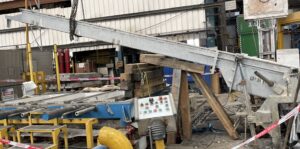
The hydraulic arm post incident

The falling arm crushed him and narrowly missed another worker.

The man was trapped for three minutes before the floor of the mould was lowered to release the pressure. However, it was a further 19 minutes before the hydraulic arm could be lifted to allow recovery.

The incident and the injuries sustained by the individual have had a dramatic impact on his day-to-day life and he has not been able to return to work.

An investigation by the Health and Safety Executive (HSE) found that the arm fell as a result of hydraulic failure. While there was a safety bar intended to prevent the arm from falling, it was not fit for purpose. Bridgnorth Aluminium Limited had not assessed the risks of the hydraulic arm falling and therefore failed to implement a suitable safe system of work to prevent employees from working beneath it.

The law requires employers to assess the risks to which their employees are exposed at work, and to implement suitable control measures to reduce the risk of harm. This includes ensuring that work equipment is fit for purpose and adequately maintained. HSE guidance explains – Managing risks and risk assessment at work – Overview -HSE.

Bridgnorth Aluminium Limited of Stourbridge Road, Bridgnorth, pleaded guilty breaching Section 2(1) of the Health and Safety at Work etc Act 1974. The company was fined £300,000 and ordered to pay £8,301 in costs at Cannock Magistrates’ Court on 13 October 2025.

HSE inspector Nicola Willcox said: “This was a serious incident that should never have happened.

“The company subsequently implemented simple control measures to prevent it from re-occurring. The process of placing the ceramic string in the moulds is now carried out with the hydraulic arm in the lowered position, and people are restricted from walking under the it when it is raised.

“If these measures had been in place at the time, then this incident would not have happened.”

This prosecution was brought by HSE enforcement lawyer Edward Parton and paralegal officer Jason Dix. The investigation was supported by Natalka Heath, HSE Visiting Officer.


Further information:

  1. The Health and Safety Executive (HSE) is Britain’s national regulator for workplace health and safety. We are dedicated to protecting people and places, and helping everyone lead safer and healthier lives.
  2. More information about the legislation referred to in this case is available.
  3. Further details on the latest HSE news releases is available.
  4. Relevant guidance can be found here: Safe use of work equipment. Provision and Use of Work Equipment Regulations 1998. Approved Code of Practice and guidance L22
  5. HSE does not pass sentences, set guidelines or collect any fines imposed. Relevant sentencing guidelines must be followed unless the court is satisfied that it would be contrary to the interests of justice to do so.  The sentencing guidelines for health and safety offences can be found here.
Plant hire company in court over work at height and welfare issues

A plant hire company has been fined for leaving workers at risk of a fall from height and failing to provide minimum welfare facilities.

Blackpool Magistrates’ Court heard how, on 17 November 2020, Ruttle Plant (Birmingham) Ltd was in the process of building a new aggregate recycling facility at their site at Common Bank Lane, Chorley. Part of the work included the provision of cladding to the roof, which was carried out using a cherry picker. However, as some areas of the roof were difficult to reach, employees had to step onto the roof where no edge protection had been provided, putting them at risk of a 30ft fall. In addition, workers had been on site for some considerable time without the minimum required welfare facilities being available. This included facilities for hand washing during the height of the Covid pandemic.

An investigation by the Health and Safety Executive (HSE) found that the workers had been left unsupervised by site management, there had been no method statement to follow when they climbed onto the roof and there were no preventative measures in place to prevent the risk of a fall from height. Workers were also expected to drive to the company’s head office along an unadopted roadway more than five minutes’ drive away to use the toilet, despite there being ample room on the site for facilities.

Ruttle Plant Hire (Birmingham) Ltd of Lancaster House, Ackhurst Road, Chorley, Lancashire pleaded guilty to breaches of Regulation 13(4)(c) of the Construction (Design and Management) Regulations 2015, and Regulation 4(1) of The Work at Height Regulations 2005. The company was fined £66,667 and ordered to pay costs of £1,847.

Speaking after the hearing, HSE inspector Christine McGlynn said: “Had a worker fallen off the roof edge, it could have been fatal. Employers should ensure that workers are not left to carry out high risk roof work without supervision.

“Work at height and roof work should only be carried out by trained workers, who are being robustly monitored, following proper planning, risk assessment and using suitable equipment. The minimum standards for welfare must also be met.”


Notes to Editors:
1. The Health and Safety Executive (HSE) is Britain’s national regulator for workplace health and safety. We prevent work-related death, injury and ill health through regulatory actions that range from influencing behaviours across whole industry sectors through to targeted interventions on individual businesses. These activities are supported by globally recognised scientific expertise. www.hse.gov.uk
2. More about the legislation referred to in this case can be found at: Construction- Roof work industry health and safety 
3. HSE news releases are available at http://press.hse.gov.uk

Company fined after employee sustains serious injuries in fall from height

A North-East manufacturer of artificial trees, plants and flowers has been sentenced after an employee suffered serious injuries when he fell from height.

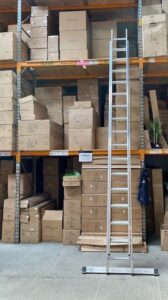
Newcastle Magistrates’ Court heard how a warehouse operative was gathering products from shelf racking. The products were stored in boxes, unwrapped on pallets up to four bays high. Access to the racking was gained by using a ladder and then either dropping the items or carrying them down to the ground. During this work, the operative slipped from the ladder and fell approximately five metres, striking his head on a pallet as he fell and sustaining a head injury.

An investigation by the Health and Safety Executive (HSE) found that Treelocate (Europe) Limited had failed to properly plan the work and had failed to ensure there was safe access to the area and that measures were taken to prevent and/or mitigate a fall from height.

Treelocate (Europe) Limited of Belford Industrial Estate, Belford, Northumberland, pleaded guilty to breaching Section 4(1) of the Work at Height Regulations 2005 and was fined £40,000 with £1,620.40 costs by Newcastle Magistrates Court.

After the hearing, HSE inspector Phil Chester said: “Treelocate (Europe) Ltd failed to suitably plan and carry out work at height in its warehouse to reduce the risk from working at height to as far as is reasonably practicable. Ladders should not just be the go-to piece of equipment for working at height and suitable planning should be done in order to remove the risk where possible.”

  1. The Health and Safety Executive (HSE) is Britain’s national regulator for workplace health and safety. It aims to reduce work-related death, injury and ill health. It does so through research, information and advice, promoting training; new or revised regulations and codes of practice, and working with local authority partners by inspection, investigation and enforcement. www.hse.gov.uk
  2. More about the legislation referred to in this case can be found at: www.legislation.gov.uk/
  3. HSE news releases are available at http://press.hse.gov.uk
  4. Further information about health and safety during working at height can be found at: https://www.hse.gov.uk/pubns/indg401.pdf


Scaffolding company fined after crane operator electrocuted

A company has been fined after a worker was fatally electrocuted whilst operating a lorry mounted crane.

Cardiff Crown Court heard how on 17 May 2016, ASL Access Scaffold Limited employee Martin Tilby was fatally electrocuted when the crane he was operating struck an overhead powerline whilst he was unloading materials in a field at Cowbridge, South Glamorgan.

An investigation by the Health and Safety Executive (HSE) found that no risk assessment had been carried out in the field where the incident happened, and no control measures were put in place to prevent contact with the overhead powerlines.

ASL Access Scaffold Limited of Bridgend Industrial Estate, Bridgend was found guilty of breaching Sections 2 (1) of the Health and Safety at Work Act 1974 and LOLER Regulation 8 (1). The company was fined £160,000 and ordered to pay costs of £45,000.

Speaking after the hearing, HSE inspector Damian Corbett said: “This death was easily preventable, and the risk should have been identified.  Employers should make sure they properly assess and apply effective control measures to minimise the risk from striking overhead powerlines. This death would have been preventable had an effective system for managing unloading materials been in place.”

Notes to Editors:

  1. The Health and Safety Executive (HSE) is Britain’s national regulator for workplace health and safety. We seek to prevent work-related death, injury and ill health through regulatory actions that range from influencing behaviours across whole industry sectors through to targeted interventions on individual businesses. These activities are supported by globally recognised scientific expertise. hse.gov.uk
  2. More about the legislation referred to in this case can be found at: legislation.gov.uk/
  3. HSE news releases are available at http://press.hse.gov.uk