Press release

Tissue manufacturer fined after worker injured hand unblocking machine

A tissue manufacturing company has been fined after an employee was seriously injured while clearing a machine blockage at its factory in Blackburn.

The 24-year-old, a lead machine operator, was working for WEPA Professional UK Limited at its premises on Waterfall Street on 31 March 2024. During the manufacturing process, a tissue blockage occurred in the rollers of the machine and the worker instructed his colleague to ‘jog’ the machine while he cleared the paper by hand.

However, as the man did this, his right hand became trapped in the roller. Although he managed pull his hand out of the machine, he had sustained crushing injuries to it.
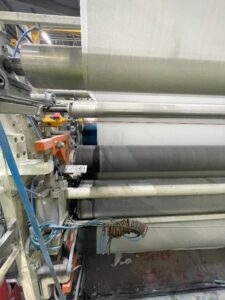
The man had been attempting to clear a tissue blockage in the rollers of the machine

An investigation by the Health and Safety Executive (HSE) found that tissue blockages were a regular occurrence at the factory, happening around 2-3 times a day. However, there was also no safe system of work in place for unblocking the tissue and the risk assessment in place at the time of the incident, which had last been reviewed in 2021, identified that formal safe operating procedures were needed to reduce risk, but this was never actioned by the company.

HSE guidance on safe use of work equipment highlights the importance of following safe isolation and lock-off procedures before carrying out any maintenance or unblocking work on machinery. Employers must ensure that equipment is properly isolated from all power sources and that systems are regularly monitored and reviewed to prevent inadvertent contact with dangerous parts of machinery.

WEPA Professional UK Limited, of Waterfall Street, Blackburn, pleaded guilty to breaching section 2(1) the Health and Safety at Work Act 1974 etc. The company was fined £60,000 and ordered to pay costs of £5,107 at Burnley Magistrates Court on 29 April 2026.

HSE principal inspector Emily Osborne said:

“A young worker was left with a serious injury as a result of an accident which could easily have been avoided.

“There was no safe system of work in place for the task as well as a lack of instructions and training to ensure workers knew how to carry out the task safely.

“Instead, the firm’s failures led to the man suffering a severe injury to his right hand.”

This prosecution was brought by HSE enforcement lawyer Gemma Zakrzewski and supported by paralegal officer Hannah Snelling.


Further information:

  1. The Health and Safety Executive (HSE) is Britain’s national regulator for workplace health and safety. We are dedicated to protecting people and places, and helping everyone lead safer and healthier lives.
  2. More information about the legislation referred to in this case is available.
  3. Further details on the latest HSE news releases is available.
  4. Relevant guidance can be found here – Safe use of work equipment – HSE.
  5. HSE does not pass sentences, set guidelines or collect any fines imposed. Relevant sentencing guidelines must be followed unless the court is satisfied that it would be contrary to the interests of justice to do so.  The sentencing guidelines for health and safety offences can be found here.
Major builders merchant fined £2.2 million after worker killed in conveyor crush

One of the country’s largest building merchants has been fined more than £2 million after one of its workers was crushed to death by a pallet of timber that weighed around three tonnes.

Paul Coulson, 56, died after a colleague started a conveyor not realising Mr Coulson had climbed inside it – resulting in the fatal crush.

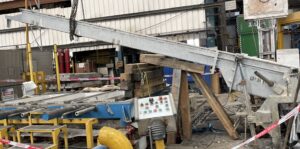
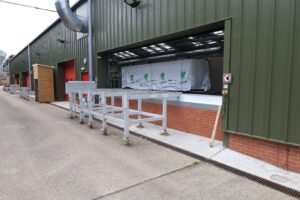
Mr Coulson was crushed by a pallet of timber that weighed around three tonnes

The incident happened on 22 May 2024 at Herringswell Sawmills, a site in Bury St Edmonds in Suffolk operated by Huws Gray Limited. Mr. Coulson, a labourer, had been tasked with removing plastic packaging from pallets of timber before they could be processed at the mill.

The 56-year had climbed within the framework of the conveyor to access some of the packaging. However, another operative, who could not see Mr Coulson from his location, started the conveyor. This resulted in the pack of timber moving forwards and colliding with him. The operative, who could see that the pack of timber was not moving along the conveyor as it should, reversed it before changing its direction. This resulted in the pack of timber moving forwards again – colliding with Mr Coulson for a second time. The crush injuries sustained were so significant that he died at the scene.

An investigation by the Health and Safety Executive (HSE) found that the company – which provides supplies to the building trade from hundreds of sites across Great Britain – had previously identified that employees were accessing the danger zone within the conveyor and placed signage asking employees not to do so. However, CCTV analysis revealed that between 14 April and 23 May 2024, operatives entered within the framework of the conveyor on 19 different occasions.

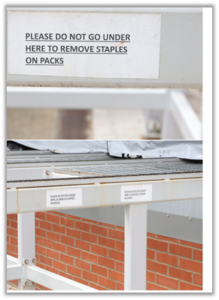
The company did places stickers on the conveyor before the incident happened

Although the company had placed stickers on the conveyor in a bid to tackle the working practice, no further action was taken to prevent access until after the tragedy.

The measures subsequently introduced to reduce the risk included guarding the conveyor to prevent access, changing the system of work so that the pallets were unwrapped before being placed on the conveyor, as well as more CCTV being installed to allow all angles to be seen by those operating it.

Although standards of health and safety are much improved over recent years, sawmilling remains a high-risk industry. HSE guidance clearly identifies the risks. Health and safety in sawmilling – HSE.

Accidents can happen when people enter dangerous parts of the machinery to carry out adjustments, clear blockages, or replenish consumables. Companies need to prevent access to the reciprocating carriage and associated machinery during normal operation.  This can be achieved by having in place:

Huws Gray Limited based in Llangefni, Anglesey, Wales, pleaded guilty to breaching the Health and Safety at Work etc Act 1974 Section 2(1).  The company was fined £2.2 million and ordered to pay full costs of £9,929 at Chelmsford Magistrates Court on the 26 March 2026.

HSE inspector Joanne Williams said:

“This was a staggering failure that has cost a man his life and robbed a family of their loved one, and the scale of the fine handed down reflects the gravity of this case.

“All companies, regardless of their size, must  follow the hierarchy of control for guarding dangerous parts within work equipment.

“Our investigation revealed that in this case, Huws Gray Ltd chose to control a serious risk through instruction alone – instead of putting proper safeguarding measures in place

“This meant employees were able to access a danger area, with tragic consequences.

“Had Huws Gray Ltd taken robust action when they became aware of the problem, Paul Coulson would be alive today.

“Our thoughts will always remain with his family and friends for the loss they have suffered.”

The case was taken by HSE Lawyers Edward Parton and Mariea Slater, supported by paralegal Gabrielle O’Sullivan.


Further information:

  1. The Health and Safety Executive (HSE) is Britain’s national regulator for workplace health and safety. We are dedicated to protecting people and places, and helping everyone lead safer and healthier lives.
  1. More information about the legislation referred to in this case is available.
  2. Further details on the latest HSE news releases is available.
  3. Relevant HSE guidance can be found here:
  4. HSE does not pass sentences, set guidelines or collect any fines imposed. Relevant sentencing guidelines must be followed unless the court is satisfied that it would be contrary to the interests of justice to do so.  The sentencing guidelines for health and safety offences can be found here.
 

Plastics firm fined after two workers lose fingers in just ten days

A company in Leeds that produces plastic products has been fined after two of its workers lost fingers in machinery in separate incidents over the course of just ten days.

Commercial Lines Limited, trading as HLN Supplies, pleaded guilty to charges brought by the Health and Safety Executive (HSE) following the two unrelated incidents in August 2024 – both caused by unsafe machinery.

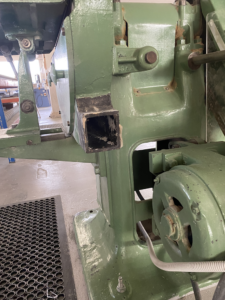
The HSE investigation found the company hadn’t put adequate guards on machinery, meaning dangerous parts were easily accessible. The first incident happened on 12 August, when Angela Morrison, a then 61-year-old grandmother, was attempting to clear a blockage on a sanding machine. The plastics fabricator reached into a ventilation port, and her hand came in contact with a large metal rotating disk, resulting in severe damage to the fingers on her right hand.

Mrs Morrison, who has eight grandchildren, and had worked for the company for 28 years, described how she was initially in shock and could not feel any pain, but was operated on within an hour of being rushed into hospital. Doctors needed to remove  what was left of her middle finger, with another finger being seriously damaged – so much so, it will also now need to be amputated.

Angela Morrison sustained serious injuries in the incident

“They are also going to remove a portion of what is left of my middle finger to make it look better,” she explained.

“I am naturally right-handed so everything is now much more difficult. You don’t notice it until you go and do something and then you realise you can’t. Little things like opening the oven or getting out change in my purse.

“My grandchildren were a bit afraid and squeamish of my injuries at first but they soon got used to it. There are things I can’t do for them that I would like to, such as doing my granddaughter’s hair.

“When I think about the accident, I just keep thinking ‘if only it didn’t happen’ or if I’d done something differently. I just want to turn the clock back.

“I have been off work since, but my long-term hope is to get back to work, even if it’s an office job.”

The sanding machine being used by Angela Morrison

Despite the wholly avoidable incident – it was only ten says later on 22 August, that another worker sustained serious injuries when his left hand came into contact with the blade of a table saw he was using to cut small strips of plastic. The 57-year-old lost part of the finger above the knuckle on his index finger and required surgery to remove the top of his middle finger several days later.

The HSE investigation found the company had failed to provide adequate guarding on the sanding machine, allowing dangerous parts to be easily accessible. Additionally, table saw training had been insufficient, and no safe work systems were in place when cutting small materials. The company also failed to have a suitable and sufficient risk assessment in place for the work being carried out.

Every year, there are a number of accidents from using work equipment, including machinery. Many are serious and some are fatal. HSE offers detailed guidance on work equipment and machinery – Work equipment and machinery – HSE.

Commercial Lines Limited (T/A HLN Supplies), of Upper Accommodation Road, Leeds, pleaded guilty to breaching Section 2(1) of the Health and Safety at Work etc. Act 1974 and section 3(1) The Management of Health and Safety at Work Regulations 1999 – They were fined £16,000 plus £6,534 in costs at Leeds Magistrates Court on 26 March 2026.

HSE Inspector Gavin Carruthers said:

“For this company to have not one but two completely avoidable incidents in such a short time shows systemic health and safety failings.

“Both workers have been left with injuries that will stay with them for the rest of their lives. The fact one of those hurt was a much-love grandmother who had worked at the company for nearly three decades makes these failings all the more stark.

“If proper guarding, training, and safe systems of work had been in place than these two workers would not have sustained such life-changing injuries.

“HSE will take action when companies fail in their duties to keep workers safe.”

This prosecution was brought by HSE Enforcement Lawyer Arfaq Nabi and paralegal officer Zara Salman


Further information:

  1. The Health and Safety Executive (HSE) is Britain’s national regulator for workplace health and safety. We are dedicated to protecting people and places, and helping everyone lead safer and healthier lives.
  2. More information about the legislation referred to in this case is available.
  3. Further details on the latest HSE news releases is available.
  4. Relevant guidance can be found here Woodworking – HSE
  5. HSE does not pass sentences, set guidelines or collect any fines imposed. Relevant sentencing guidelines must be followed unless the court is satisfied that it would be contrary to the interests of justice to do so.  The sentencing guidelines for health and safety offences can be found here.

Much loved man lost his life ‘due to cost of 50 pence screw’ say family

The family of a much loved man from Cumbria have spoken of their anger that his life was worth less than “the cost of a 50 pence screw”.

Alban Watts was killed while working for egg producer Bell Mount Farming Limited at its site in Great Salkeld in Penrith on 11 January 2023. The 61-year-old, who lived in the village of Blencow, died after being strangled, when his clothes became entangled in a hen feeding system at the farm.

Alban Watts was killed when his clothing became entangled in unguarded machinery

Speaking after the company was fined £50,000, his brother Martin and sister Louise Robinson spoke of their sadness and anger at his death.

“Losing Alban has taken a part of our trio, without him we are an incomplete unit,” the siblings said.

“Not a day goes by where he is not missed.

“Alban worked at Bell Mount for 12 years and he enjoyed his job. But it’s taken the life of a member of our family for them to do their job.

“We are angry that his life was worth less than a 50p screw to a multi-million pound company. Such a small item could have saved his life. You can’t replace a person who meant so much to us.”

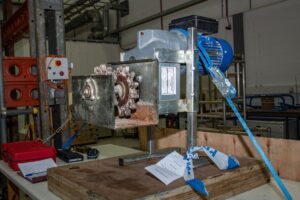
The machine was examined at HSE’s site in Buxton

An investigation by the Health and Safety Executive (HSE) found that Bell Mount Farming Limited failed to prevent access to dangerous parts of machinery – in this case the rotating sprocket of the drive mechanism which powered the feeding system  in the poultry shed. The system operated for three minute periods at set times throughout the day; the remainder of the time it was motionless.

Mr Watts was working alone in one of the poultry sheds when his clothing came into contact with the unguarded sprocket during one of these feeding periods, causing it to become entangled. The investigation also identified that the guard designed to prevent such access was not fixed in place and could simply be lifted off.

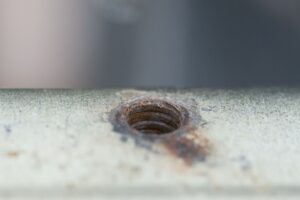
Further examination of the guard identified that the bolt holes in the guard were stripped, preventing it from being secured to the frame of the drive unit.  Additionally, these holes in the guard did not align with those in the frame, making it impossible for the guard to be fixed securely.

One of the bolt holes on the guard

Alban’s mother Noreen said her son was an accomplished mechanic, joiner and carpenter and that his death had been ‘cruel’.

“Mere words cannot express the horror and distress of hearing such an awful death and I can only hope Alban didn’t suffer,” she said.

“I have now had to go through every parent’s nightmare of surviving their own child, in tragic circumstances.

“Above all, I want lessons to be learnt from this tragedy.

“Due to the lack of a machine guard, my dear son Alban has been killed and taken from me.”

HSE guidance states employers must take effective measures to prevent access to dangerous parts of machinery.  This will normally be fixed guards which prevent persons coming into contact with those parts and require a tool to be removed; this was the expected control in this instance.  Further guidance can be found here Provision and Use of Work Equipment Regulations 1998 (PUWER) – HSE.

Bell Mount Farming Limited, of Stainton, Penrith, pleaded guilty to breaching Regulation 11(1)(a) of the Provision and Use of Work Equipment Regulations 1998. The company was fined £50,000 and ordered to pay £6,038 in costs at a hearing at Warrington Magistrates’ Court on 20 November 2025.

After the hearing HSE Inspector Matthew Shepherd said: “What is most tragic about this case is the failure of the company was such a basic and simple one.

“What was such an easy fault to fix cost a much loved man his life and left a family without a brother and a son.

“Preventing access to dangerous parts of machinery is a well-known and long-standing part of any health and safety management system.

“Alban’s death shows the importance of ensuring machinery is adequately guarded and the devastating consequences of getting it wrong.

“We will not hesitate to take action against companies which do not do all that they should to keep people safe.”

This HSE prosecution was brought by HSE enforcement lawyer Matthew Reynolds and paralegal officer Farhat Basir.


Further information:

  1. The Health and Safety Executive (HSE) is Britain’s national regulator for workplace health and safety. We are dedicated to protecting people and places, and helping everyone lead safer and healthier lives.
  2. More information about the legislation referred to in this case is available.
  3. Further details on the latest HSE news releases is available.
  4. Relevant guidance can be found here Provision and Use of Work Equipment Regulations 1998 (PUWER) – HSE
  5. HSE does not pass sentences, set guidelines or collect any fines imposed. Relevant sentencing guidelines must be followed unless the court is satisfied that it would be contrary to the interests of justice to do so.  The sentencing guidelines for health and safety offences can be found here.
 

Aluminium manufacturer fined £300,000 after worker crushed

A manufacturer of rolled aluminium products has been fined £300,000 after a worker was crushed under a 1.5-tonne hydraulic arm at its site in Bridgnorth.

The man, in his early 40s, was working underneath the arm when it failed, resulting in life-changing crush injuries. He had been working for Bridgnorth Aluminium Limited at its site in the town when the incident happened on 10 May 2023.

He had been carrying out preparation work for the casting of aluminium blocks from molten aluminium. He was kneeling inside a casting mould, wearing heat resistant clothing, to insert ceramic string around its edges. The hydraulic launder arm above the mould, which is used to transport molten metal around the foundry, suddenly fell onto him. It is believed the exterior temperature of the launder arm was around 100°C.

The hydraulic arm post incident

The falling arm crushed him and narrowly missed another worker.

The man was trapped for three minutes before the floor of the mould was lowered to release the pressure. However, it was a further 19 minutes before the hydraulic arm could be lifted to allow recovery.

The incident and the injuries sustained by the individual have had a dramatic impact on his day-to-day life and he has not been able to return to work.

An investigation by the Health and Safety Executive (HSE) found that the arm fell as a result of hydraulic failure. While there was a safety bar intended to prevent the arm from falling, it was not fit for purpose. Bridgnorth Aluminium Limited had not assessed the risks of the hydraulic arm falling and therefore failed to implement a suitable safe system of work to prevent employees from working beneath it.

The law requires employers to assess the risks to which their employees are exposed at work, and to implement suitable control measures to reduce the risk of harm. This includes ensuring that work equipment is fit for purpose and adequately maintained. HSE guidance explains – Managing risks and risk assessment at work – Overview -HSE.

Bridgnorth Aluminium Limited of Stourbridge Road, Bridgnorth, pleaded guilty breaching Section 2(1) of the Health and Safety at Work etc Act 1974. The company was fined £300,000 and ordered to pay £8,301 in costs at Cannock Magistrates’ Court on 13 October 2025.

HSE inspector Nicola Willcox said: “This was a serious incident that should never have happened.

“The company subsequently implemented simple control measures to prevent it from re-occurring. The process of placing the ceramic string in the moulds is now carried out with the hydraulic arm in the lowered position, and people are restricted from walking under the it when it is raised.

“If these measures had been in place at the time, then this incident would not have happened.”

This prosecution was brought by HSE enforcement lawyer Edward Parton and paralegal officer Jason Dix. The investigation was supported by Natalka Heath, HSE Visiting Officer.


Further information:

  1. The Health and Safety Executive (HSE) is Britain’s national regulator for workplace health and safety. We are dedicated to protecting people and places, and helping everyone lead safer and healthier lives.
  2. More information about the legislation referred to in this case is available.
  3. Further details on the latest HSE news releases is available.
  4. Relevant guidance can be found here: Safe use of work equipment. Provision and Use of Work Equipment Regulations 1998. Approved Code of Practice and guidance L22
  5. HSE does not pass sentences, set guidelines or collect any fines imposed. Relevant sentencing guidelines must be followed unless the court is satisfied that it would be contrary to the interests of justice to do so.  The sentencing guidelines for health and safety offences can be found here.

Fine for flour mill after workers severs finger

A Northamptonshire-based flour company has been fined £300,000 after a maintenance worker severed one of his fingers in machinery.

The incident happened at ADM Milling Limited at its site on Earlstrees Industrial Estate in Corby on 28 June 2023.

David Wood, who was 59 at the time, had been carrying out maintenance work on a packer closing station. However, the 800-kilogram machine became unbalanced and tipped backwards, trapping his left hand. This resulted in the little finger on the hand being severed.

A yellow brace was installed on the machine following the incident

The incident was investigated by the Health and Safety Executive (HSE) which found the company had failed to safely manage the risks of people performing maintenance at its factory.

ADM Milling Limited were required to fully assess the task that the injured person was assigned, to ensure that his health and safety was not put at risk.

HSE guidance states that maintenance work needs to be correctly planned and carried out. Unsafe maintenance has caused many fatalities and serious injuries, either during the work or as a result of using badly/wrongly maintained machines. Further guidance can be found here: Maintenance of work equipment – HSE

ADM Milling Limited, of Brunel Road, Earlstrees Industrial Estate, Corby, Northamptonshire, pleaded guilty to breaching Section 3(1) of the Health and Safety at Work, etc. Act 1974. The company was fined £300,000 and ordered to pay £7,517 in costs at Northampton Magistrates Court on 4 June 2025.

HSE inspector Abbey Hodson said: “This incident was wholly avoidable.

“The case should highlight to industry that all maintenance tasks, whether they are planned or unplanned, should be carefully assessed and reviewed to ensure that anyone under their control is protected from harm.

“Had this task been competently risk assessed, other control measures that prevented this incident would have been identified.”

The HSE prosecution was brought by HSE enforcement lawyer Samantha Wells and paralegal officer Helen Hugo.

Further Information:

  1. The Health and Safety Executive (HSE) is Britain’s national regulator for workplace health and safety. We are dedicated to protecting people and places, and helping everyone lead safer and healthier lives.
  2. More information about the legislation referred to in this case is available.
  3. Further details on the latest HSE news releases is available.
  4. Relevant guidance can be found here Maintenance of work equipment – HSE
  5. HSE does not pass sentences, set guidelines or collect any fines imposed. Relevant sentencing guidelines must be followed unless the court is satisfied that it would be contrary to the interests of justice to do so.  The sentencing guidelines for health and safety offences can be found here.
Lincolnshire food manufacturer fined after employee crushed in cooking machine

A Lincolnshire-based food manufacturer has been fined after one of its employees sustained two broken ribs having been crushed within an industrial cooking machine whilst working to clear a blocked water inlet.

Lincoln Magistrates’ Court heard how the employee was crushed in the machine after its safety systems were over-ridden and the machine worked on whilst it was live. It should have been isolated before work on it began.

An investigation carried out by the Health and Safety Executive (HSE) found that the task was carried out by the employees in this fashion on a regular basis and that the company should have been aware .  No risk assessment of the task had been completed and employees had not been provided with a safe system of work to carry it out.  The lack of a safe system of work for the task and the company’s failure to monitor how the work was done, led employees to devise their own way of conducting the procedure which included  over-riding the safety systems and using unsafe working practices.

Bakkavor Fresh Cook Ltd of Sluice Road, Holbeach St Marks Spalding pleaded guilty of one breach of Section 2(1) of the Health and Safety at Work etc. Act 1974 and were fined £130,000 and ordered to pay costs of £2607.10.

At the end of the trial HSE inspector Tim Nicholson commented: “Those in control of work have a responsibility to devise safe methods of working and to provide the necessary information, instruction and training to their workers.  If a suitable safe system of work had been in place prior to this incident, alongside good monitoring of the way the work was done, the injuries sustained by the employee could have been prevented.”

Notes to Editors:

  1. The Health and Safety Executive (HSE) is Britain’s national regulator for workplace health and safety. We prevent work-related death, injury and ill health through regulatory actions that range from influencing behaviours across whole industry sectors through to targeted interventions on individual businesses. These activities are supported by globally recognised scientific expertise. hse.gov.uk
  2. More about the legislation referred to in this case can be found at: legislation.gov.uk
  3. Information regarding how to safely carry out maintenance tasks can be found on the HSE website at hse.gov.uk/safemaintenance
  4. HSE news releases are available at http://press.hse.gov.uk