Press release

Company fined after employee seriously injured by reversing flat-bed truck

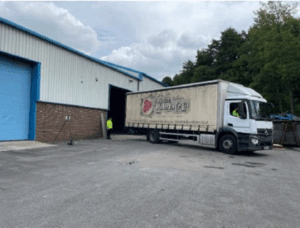
A landscaping and civil engineering company has been fined £125,000 after a man was seriously injured when struck by a reversing vehicle in Wolverhampton.

The 58-year-old employee of Jack Moody Landscaping and Civil Engineering Limited suffered life-changing injuries after a visiting flatbed truck reversed into him as he walked across the company’s site at Hollybush Farm on Warstone Road on 22 September 2017. The worker sustained serious head injuries, damage to his eyesight, and significant mental and psychological trauma.

An investigation by the Health and Safety Executive (HSE) found that the workplace had not been organised to allow pedestrians and vehicles to circulate safely. There were no clearly demarcated pedestrian routes, no instructions for drivers on safe vehicle manoeuvring, and inadequate arrangements to ensure vehicles could reverse without risk to those on foot.

Nearly a quarter of all deaths involving workplace transport occur during reversing. Many other reversing accidents do not result in injury but cause costly damage to vehicles, equipment and premises.

HSE guidance on reversing advises to remove the need for reversing altogether by setting up one-way systems, for example drive-through loading and unloading positions. Where reversing is unavoidable, routes should be organised to minimise the need for reversing.

Jack Moody Landscaping and Civil Engineering Limited, of Hollybush Farm, Warstone Road, Shareshill, Wolverhampton, was found guilty of breaching Section 2(1) of the Health and Safety at Work etc Act 1974 following a trial at Wolverhampton Crown Court in November 2025. The company was fined £125,000 and ordered to pay £150,000 in costs at a sentencing hearing at the same court on 15 June 2026.

Speaking after the hearing, HSE Principal Inspector Laura Royales said:

“This was a completely avoidable incident, caused by the company’s failure to put in place very straightforward measures to separate vehicles and pedestrians.

“Workplace transport incidents remain one of the most common causes of fatal injuries in this sector, and it is fortunate that this incident did not prove fatal.

“Employers must ensure their workplaces are properly organised to keep workers safe.”

Further information:

  1. The Health and Safety Executive (HSE) is Britain’s national regulator for workplace health and safety. We are dedicated to protecting people and places, and helping everyone lead safer and healthier lives.
  2. More information about the legislation referred to in this case is available.
  3. Further details on the latest HSE news releases are available.
  4. Relevant guidance can be found here: Introduction to workplace transport safety – HSE
  5. HSE does not pass sentences, set guidelines or collect any fines imposed. Relevant sentencing guidelines must be followed unless the court is satisfied that it would be contrary to the interests of justice to do so.  The sentencing guidelines for health and safety offences can be found here.

Recycling company fined after employee suffers life-changing injuries in telehandler incident

A waste and recycling company has been fined after an employee suffered life-changing injuries after being crushed by a reversing telehandler at a site in Lancashire.

Jordan Campion, from Burnley, was working for Sheridan Skips Burnley Limited at its site in Smiths Yard, Clifton Street when the incident occurred on 12 March 2024.

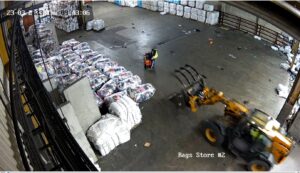
Mr Campion, now 21, and three other employees were sorting and separating waste material by hand in the same yard as a colleague who was operating a telehandler. Mr Campion was standing against a brick wall at the side of the yard when the telehandler reversed into him, crushing him against the wall.
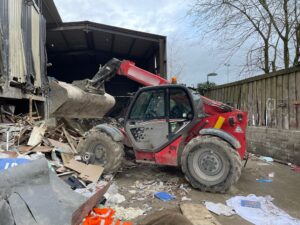
The telehandler involved in the incident

As a result, Mr Campion suffered multiple fractures, nerve damage to his right arm and internal organ injuries. He also lost partial hearing in his right ear and developed a blood clot which caused optical damage to his right eye, resulting in permanent sight loss in that eye.

An investigation by the Health and Safety Executive (HSE) found that Mr Campion and other employees frequently worked in the yard while vehicles operated alongside them. Sheridan Skips Burnley Limited had not undertaken a suitable and sufficient assessment of the risks and failed to provide adequate measures for the safe segregation of vehicles and pedestrians. There was no physical protection from vehicle movement, which regularly put employees in considerable danger.

The investigation also found that the telehandler operator could not see clearly while reversing, as the machine was missing mirrors to aid reversing — a deficiency the company had failed to address.

Workplace transport safety and hand sorting of recyclables with vehicle assistance provides advice for employers on what they need to do to comply with the law and reduce risk. The guide is also useful for managers, supervisors, employees and their safety representatives, as well as contractors, vehicle operators and other organisations concerned with workplace transport safety.

Mr Campion was in hospital for nearly two weeks following the incident. In his victim personal statement, Mr Campion said: “My incident has caused my family great distress. They permanently worry about me; they never thought that I wouldn’t be safe in work. They say you never expect to see your child go off to work and to get a phone call to say that they have had an incident and might not survive.”

Sheridan Skips Burnley Limited, of Cathedral Gates, Manchester, pleaded guilty to breaching Section 2(1) of the Health and Safety at Work etc. Act 1974. The company was fined £24,000 and ordered to pay £4777 in costs at Blackburn Magistrates’ Court on Wednesday 11 March 2026.

After the hearing, HSE inspector Anthony Banks said: “This young man’s injuries could so easily have been avoided with the implementation of safe working practices, including pedestrian and vehicle segregation and safe refuges for workers whilst vehicles were operating. These measures would have ensured that workers present in the yard were not put at risk of being struck by vehicles moving in and around where they were working.

“This should serve as a reminder to businesses operating in the waste industry to ensure that workplace transport is appropriately considered, with control measures introduced to ensure the appropriate separation of vehicles and pedestrians.”

The prosecution was supported by HSE enforcement lawyer Julian White and paralegal officer Hannah Snelling.

Further information:

  1. The Health and Safety Executive is Britain’s national regulator for workplace health and safety. We are dedicated to protecting people and places, and helping everyone lead safer and healthier lives.
  2. More information about the legislation referred to in this case is available.
  3. Further details on the latest HSE news releases are available.
  4. Relevant guidance can found here: Workplace transport safety and hand sorting of recyclables with vehicle assistance.
  5. HSE does not pass sentences, set guidelines or collect any fines imposed. Relevant sentencing guidelines must be followed unless the court is satisfied that it would be contrary to the interests of justice to do so. The sentencing guidelines for health and safety offences in England and Wales can be found here and for those in Scotland here.

Protecting workers from workplace transport: getting the basics right

Every year, families across Great Britain face the devastating loss of a loved one killed by a reversing vehicle at work. These are not just statistics. They are family members, friends and colleagues whose lives were cut short by entirely preventable accidents.

The stark reality is that being struck by a moving vehicle accounts for 16% of all fatal work-related injuries, claiming an average of 21 lives annually over the past 5 years, making it one of the leading causes of work-related fatalities in Great Britain.

Looking at these incidents we see that many feature the same pattern – reversing vehicles.

Recent months have brought this issue into sharp focus, with fines reaching £2.5 million as case after case reveals the same preventable failures.

“What strikes me most about these cases is not the complexity of the failures, but their simplicity,” says John Rowe, Deputy Director for Technical Support and Engagement at the Health and Safety Executive (HSE). “Time and again, we see deaths that could have been prevented by basic measures that cost far less than the fines that are ultimately imposed.”

The pattern is clear across multiple industries including agriculture (27% of vehicle deaths), construction, and transportation and storage (17% each). But the solutions are equally clear, if employers are willing to implement them properly.

Why these incidents happen

Workplace transport fatalities follow predictable patterns. Workers are struck by reversing vehicles in yards where pedestrians and vehicles share space. Drivers cannot see properly because reversing aids are broken or missing. Sites lack traffic management. There are no designated safe routes for people on foot.

These incidents occur when safety is treated as optional. Delivery schedules take priority over having a banksman present. Reversing cameras stay broken because fixing them seems expensive. Pedestrian walkways are never created because “we’ve always managed without them.” Or they are created but their use is not enforced – potentially creating an even more dangerous situation on site.

Preventing vehicle-related deaths means making safety fundamental to how sites operate. This must happen before any vehicle moves. It requires understanding risks and committing to control them properly.

How to prevent these incidents

Safe site design separates people from vehicles wherever possible. This means creating dedicated walkways with physical barriers, using one-way traffic systems to reduce reversing, and designating loading areas away from where people work. Sites need proper lighting so drivers can see clearly throughout the day. Pedestrian routes must be visible and obvious to everyone.

Vehicles must be maintained and fit for purpose. Reversing aids are essential safety equipment, not extras. CCTV systems, audible alarms and sensors help drivers detect hazards they cannot see directly. These systems only protect workers when they are working properly. Regular vehicle checks must be standard practice. Any vehicle with defects must be taken out of service until repairs are completed.

People remain central to safe operations. Sites need drivers who understand the specific risks they face, know when to request a banksman, and feel able to stop work if conditions become unsafe. This applies to regular staff, visiting drivers and contractors who may not be familiar with the site. Training must go beyond basic vehicle operation to cover the realities of working safely in each specific environment.

It is not enough to just implement the necessary precautions, it is just as important to ensure that employees, and drivers, maintain standards or follow safe working practices.  Managers and supervisors should routinely challenge and investigate unsafe behaviours they come across.

Moving forward

The £1 million and £2.5 million fines making headlines represent more than financial penalties. They mark families destroyed by entirely preventable failures. Agriculture, forestry and fishing loses six workers annually to vehicle strikes, construction, and transportation and storage each lose four, but every sector sees deaths that proper management could eliminate.

Preventing workplace transport deaths requires organisations to implement proven control measures consistently. This means conducting thorough risk assessments, maintaining equipment rigorously, and empowering workers to identify hazards before incidents occur.

You can find comprehensive guidance on workplace transport on our website.

Notes to editors

Company fined after much loved family man killed by reversing HGV

A manufacturing company has been fined £240,000 after a grandfather was killed by a reversing HGV in Birmingham.

David Saint – described as ‘my everything’ by his daughter – worked as an engineering manager at Northwood Consumer Limited, at its site in Electra Park, Electric Avenue.

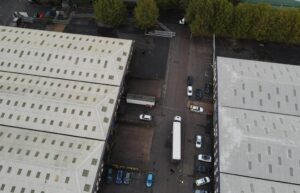
The 61-year-old, from Spalding in Lincolnshire, was walking across the service road on the shared industrial estate on 19 October 2023, when the reversing HGV collided with him.

Mr Saint leaves behind his wife, Cassandra, his children Samantha and Adam, his grandchildren, Jake and Ava, as well as his father, Terry, and siblings, Paul, Kim and Michael.

David Saint was killed by a reversing HGV

His daughter, Samantha, said: “He was my everything, there was nothing he wasn’t involved in.

“My life now consists of ‘what would dad do?’

“I think of him and miss him every day.”

An investigation by the Health and Safety Executive (HSE) found that Northwood Consumer Limited failed to:

HSE guidance provides advice for employers on what they need to do to comply with the law and reduce risk. The guide is also useful for managers, supervisors, employees and their safety representatives, as well as contractors, vehicle operators and other organisations concerned with workplace transport safety.

A police drone captured this image of the aftermath of the incident

Mr Saint’s son Adam added: “I just miss my dad being there.

“I miss the conversations that we used to have and his guidance.

“I just miss everything about him.”

Northwood Consumer Limited of  Northwood House, Stafford Park 10, Telford, pleaded guilty to breaching Sections 2(1) and 3(1) of the Health and Safety at Work etc Act 1974. The company was fined £240,000 and ordered to pay £6,917 in costs at Birmingham Magistrates Court on 6 October 2025.

Lead HSE inspector Charlie Rowe said: “This is a tragic and shocking case that has devastated Mr Saint’s family, friends and loved ones.

“Pedestrians being struck by moving vehicles remains a leading cause of workplace fatalities in Great Britain.

“Many of these incidents involve the reversal of vehicles with poor visibility, such as HGVs.

“The HSE will continue to take appropriate enforcement action where employers fail to implement reasonably practicable measures to keep people safe.

“My thoughts remain with all of David’s family and friends.”

This prosecution was brought by HSE enforcement lawyer Edward Parton and supported by senior paralegal manager Sarah Thomas.


Further information:

  1. The Health and Safety Executive (HSE) is Britain’s national regulator for workplace health and safety. We are dedicated to protecting people and places, and helping everyone lead safer and healthier lives.
  2. More information about the legislation referred to in this case is available.
  3. Further details on the latest HSE news releases is available.
  4. Relevant guidance can be found at Workplace transport – HSE.
  5. HSE does not pass sentences, set guidelines or collect any fines imposed. Relevant sentencing guidelines must be followed unless the court is satisfied that it would be contrary to the interests of justice to do so.  The sentencing guidelines for health and safety offences can be found here.

Global glass bottle maker fined £600k after worker injured

A global glass bottle manufacturer has been fined £600,000 after a worker was burnt by molten glass and hot water spilling into his cab.

O-I Glass Limited pleaded guilty to one charge following the incident at its Glasshouse Loan site in Alloa on 3 February 2024.

A 32-year-old man suffered scald burns to 8 percent of his body but has since been able to make a full recovery.

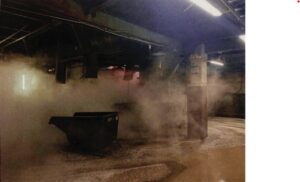
The basement of the site and the skips being used to collect waste product

The company, which employs around 500 people at the site, continually operates furnaces that are used to smelt raw materials, from which glass bottles are manufactured. The furnaces and production lines are located on the floor above two glass reject basements, which house a number of large, moveable skips. It is into these skips that molten or formed glass is rejected, via chutes, during the production process. Coolant water runs down each chute with the rejected molten or formed glass, which in turn generates very hot water and large amounts of steam.

Due to the continuous nature of the operation, the skips would quickly fill and sometimes reject material and water would spill from the skips onto the basement floors. Employees working in these basements used shovel loaders to clear this spilled material from the floors, which was then emptied into other skips.

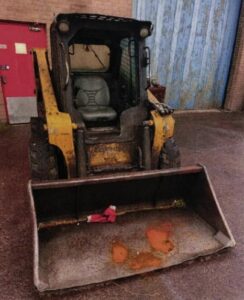
On the day in question, the worker had been operating a shovel loader, clearing the waste molten glass and hot water from the basement floor. However, there was no protective door on the cab of the vehicle, so some of that material spilled from the bucket onto him.

The shovel loader with missing protective door

When it was first provided for use, the loader was fitted with a protective door incorporating a glass window, in front of the cab. However, an investigation by the Health and Safety Executive (HSE) established that the protective door had been missing since March 2022. It had been removed from the vehicle after being damaged, and although this was reported to the site engineer at the time, no action was taken to replace it. In the almost two years that went by, other operatives had reported being struck or having footwear burnt by molten glass falling into the cab.

HSE guidance, specifically the publication “A guide to workplace transport safety – HSE (HSG136) paragraph 219 & 220: states that ‘vehicles should be fitted with additional protection for those working ….in an inhospitable working environment…. where there is a risk of being struck by falling objects, the vehicle should be fitted with a falling-object protective structure (FOPS)’ and Safe use of work equipment – HSE (Approved Code of Practice to the Provision and Use of Work Equipment Regulations 1998 (PUWER))

Following the incident, the company removed the vehicle from service, and it didn’t return until June 2024, after being fitted with a steel front door, incorporating a glass window with protective wire mesh.

O-I Glass Limited, of Edinburgh Way, Harlow, Essex, pleaded guilty to Regulation 5 (1) of The Provision and Use of Work Equipment Regulations 1998 and section 33(1) of Health and Safety at Work etc Act 1974 for failing to maintain the vehicle in an efficient state, in efficient working order and in good repair. The company was fined £600,000 at Stirling Sheriff Court on 23 September 2025.

HSE inspector Kathy Gostick said: “This was an avoidable ordeal for a young worker. It is sheer luck he has been able to recover from his serious injuries.

“This company’s employees worked in this environment with a safety critical part of the loader missing for a period of almost two years.

“Although the protective front door had been removed and reported to the on-site engineer, drivers had continued to work and operate the loader with it missing.

“Some operatives even described being struck or having footwear burnt by molten glass falling into the cab as a result.

“When work equipment is being selected, its suitability for the environment it is going to be used in must be risk assessed. In this case the protective door was not suitable to protect against impacts from hot and molten glass and therefore was often broken and in the end never replaced. Had an appropriate door been selected and maintained in place this accident would not have occurred.”


Notes to Editors

  1. The Health and Safety Executive (HSE) is Britain’s national regulator for workplace health and safety. We are dedicated to protecting people and places, and helping everyone lead safer and healthier lives.
  2. More information about the legislation referred to in this case is available.
  3. Further details on the latest HSE news releases is available.
  4. HSE does not pass sentences, set guidelines or collect any fines imposed. Relevant sentencing guidelines must be followed unless the court is satisfied that it would be contrary to the interests of justice to do so.  The sentencing guidelines for health and safety offences in Scotland can be found here.