Press release

Offshore firm fined following death of worker on Valaris 121 whose body was never recovered

An offshore firm has been handed a £267,000 fine after a long-running HSE investigation found that crewman Jason Thomas was killed when he fell through a missing deck grate and was lost to the North Sea.

Ensco Offshore UK Limited (EO UK Ltd) was responsible for the operation of the Valaris 121 installation when the incident occurred on 22 January 2023.

Jason Thomas, 50, from South Wales, was an experienced offshore worker with around 16 years in the industry. At the time of his death, he was employed by Ensco Services Limited, a wholly owned company of EO UK Ltd, where he had progressed from roustabout to deck foreman and then crane operator.
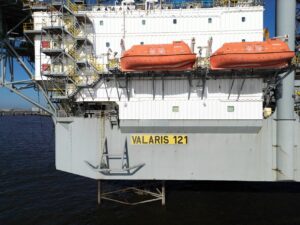
The incident aboard Valaris 121 when it was under tow

After he went missing on 22 January 2023, an HM coastguard search was launched and called off the following day, though Jason’s body was never recovered. HSE carried out a full investigation to find out what happened.

HSE’s findings: how the incident unfolded

A thorough investigation by the Health and Safety Executive (HSE) found that the grating panel had not been secured in line with the original equipment manufacturer’s (OEM) specifications, and that later inspections had not checked the deployment of Hilti clips, which are used to secure gratings to their substructures and stop them coming loose

On the morning of 22 January, the rig’s hull was afloat and under tow towards Dundee for maintenance. As the day progressed, weather conditions deteriorated significantly, with windspeeds exceeding 30 miles per hour and wave heights well above five metres.

Mr Thomas, who was supervising the deck team during his shift, completed water integrity checks with a colleague at around 2pm. Both men had taken water over their boots during the checks. Mr Thomas was observed removing his coveralls and leaving his hard hat and gloves near the airlock door before changing into training shoes.

At approximately 2.30pm, he was seen taking a break in one of the staff lounges. Around 15 minutes later, a mechanic entered carrying a lifebuoy that had become detached from its holder on the main deck. Mr Thomas told him to leave it in the lounge and that he would ‘deal with it’. He was last seen at around 3.05pm leaving the lounge with a cup of coffee and his mobile phone.

At around 4pm, a colleague in the boot room heard a loud noise from outside. On opening the door to deck 1, he found that the grating immediately outside had been displaced, leaving a void above the waters of the North Sea. The control room was alerted immediately, but repeated tannoy calls failed to locate Mr Thomas. HM Coastguard was eventually contacted several hours later, shortly before 9pm.
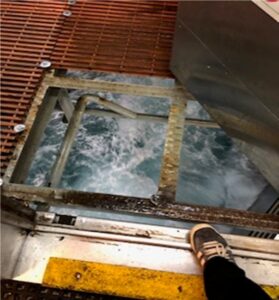
The missing grate was directly in front of the door to the deck

During the subsequent search of the rig, Mr Thomas’s hard hat, gloves and radio were found near the airlock door. His coveralls were never recovered. A search and rescue operation was launched under the direction of HM Coastguard but was called off the following day.

Mr Thomas’s mother subsequently obtained a Presumed Death Certificate through the Welsh Courts, confirming that he died on 22 January 2023. She passed away shortly after receiving this confirmation.

The HSE investigation further concluded that wave action over the course of the afternoon had applied sufficient upward force to the grating to cause the fixings to fail and displace it. The possibility of malicious interference was considered but ruled out following examination at HSE’s Buxton scientific facility, where no tool marks were found on the fixings or clips.

Following the incident, the company replaced all polymer grating across its fleet with galvanised steel grating.
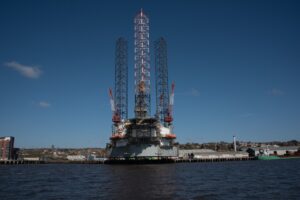
Valaris 121 was being taken back to Dundee

Ensco Offshore UK Limited pleaded guilty to breaching Section 3(1) and 33(1)(a) of the Health and Safety at Work etc. Act 1974. At Aberdeen Sheriff’s Court on 18 May 2026, the company was fined £267,000 with an added victim surcharge of £20,025 also imposed taking the total payable to £287,025.

HSE principal inspector Stephen Hanson Hall said:

“This was a profound tragedy which left lasting mark on Jason’s colleagues and his community.

“Jason Thomas was an experienced offshore worker who lost his life in the most unimaginable way possible. The fact his body was never found resulted in great anguish to his mother, who has also since died.

“The investigation was incredibly complex and thorough and we hope it has provided Mr Thomas’ remaining family with some reassurance that we did everything we could to secure them justice.

“Grating systems must be designed, installed and maintained so that they do not present a risk to anyone that may use them, particularly when used in environments where they are susceptible to damage.

“Had the company taken relatively simple measures to identify and control the underlying risks, particularly during the rig move, it is highly likely the incident would never have occurred, and Jason would have returned home.”

Ensco Offshore UK Limited pleaded guilty to breaching Section 3(1) and 33(1)(a) of the Health and Safety at Work etc. Act 1974. The company was fined at Aberdeen Sheriff’s Court on 18 May 2026.


Further information:

  1. The Health and Safety Executive (HSE) is Britain’s national regulator for workplace health and safety. We are dedicated to protecting people and places, and helping everyone lead safer and healthier lives.
  2. More information about the legislation referred to in this case is available.
  3. Further details on the latest HSE news releases is available.
  4. HSE does not pass sentences, set guidelines or collect any fines imposed. Relevant sentencing guidelines must be followed unless the court is satisfied that it would be contrary to the interests of justice to do so.  The sentencing guidelines for health and safety offences in Scotland can be found here.
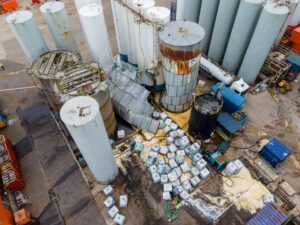
Company fined £350,000 after chemical tank collapse left worker with life-changing injuries

A company has been fined £350,000 after the catastrophic collapse of a storage tank at its Peterhead premises which left a self-employed worker with life-changing injuries.

The Health and Safety Executive (HSE) investigated the incident, which occurred on 21 June 2023 at Tetra Technologies UK Limited’s offshore supply base. The base handles around two thousand ship movements per year, supplying North Sea oil and gas installations with deck cargos and quantities of fluids.

A still of drone footage captures the aftermath

Philip Moir, a 62-year-old self-employed rope access technician, was on site conducting surveys of storage tanks when Tank 7 — a bolted steel tank holding approximately 480,776 litres of calcium chloride solution weighing around 700 tonnes — catastrophically ruptured without warning.

Mr Moir was almost immediately immersed to chest height in the released fluid. He was subsequently found slumped over the wheel of a nearby cherry picker, which itself, along with a Ford Transit pickup, a small skip and the cherry picker — weighing twelve and a half tonnes — had all been displaced by the force of the escaping fluid.

The 700-tonne tank was more than 30 years old

Mr Moir sustained a double fracture of his spine and pelvis, lacerated liver, punctured lung, multiple rib fractures, fractured sternum, a fractured wrist, and extensive chemical burns requiring skin grafts. He has not worked since the incident and is unable to climb ladders or work at height, injuries described as life-changing.

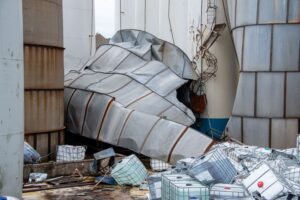
HSE’s investigation, conducted by both regulatory and specialist inspectors, identified that the structural failure occurred around halfway up the tank shell, where the third row of plates split vertically along a bolted seam. Approximately 4.5mm of the original 5.5mm steel plate had been lost through corrosion over time, leaving just 1mm of steel unable to withstand the outward forces of the fluid within. Investigators found that the loss of any protective coating had left the steel surfaces exposed to aggressive coastal air, accelerating external degradation. The density of calcium chloride — more than one third denser than water — further increased the forces applied to the already weakened structure.

HSE inspectors arrived on site and took this photo of the scene

The tank was more than 30 years old and the manufacturer’s maintenance manual required six-monthly checks of seams and bolts, and annual external inspections for corrosion. An inspection in 2013 had already identified extensive outer surface corrosion over the lower section of the tank and corrosion at bolted connections, yet no remedial work was carried out on Tank 7. The company was unable to provide evidence of any regular inspection regime being followed in the years that followed.

On the morning of the incident, Tank 7 had been filled to capacity — a step taken to create space at the company’s Aberdeen premises — and failed less than thirty minutes after the final load was pumped in. HSE concluded that the failure of the tank was wholly foreseeable and preventable.

Following the incident, the company removed all bolted tanks from its sites and closed its Peterhead operation, relocating to its Aberdeen premises.

Tetra Technologies UK Limited of One Fleet Place, London, pleaded guilty to breaches under sections 3(1) and 33(1)(a) of the Health and Safety at Work Act etc. 1974. The company was fined £350,000 at Peterhead Sheriff Court on 13 May 2026.

HSE Inspector Mark Carroll said:

“This was a completely preventable incident.

“The corrosion that caused this tank to fail had been identified a decade before it collapsed, yet no remedial action was taken and there is no evidence that the required inspection regime was ever consistently followed.

“A worker has been left with life-changing injuries as a direct consequence of those failures.

“Companies have a legal duty to maintain equipment in an efficient state and good repair, and HSE will not hesitate to take action where that duty is not met.”


Further information.

  1. The Health and Safety Executive (HSE) is Britain’s national regulator for workplace health and safety. We are dedicated to protecting people and places, and helping everyone lead safer and healthier lives.
  2. More information about the legislation referred to in this case is available.
  3. Further details on the latest HSE news releases is available.
  4. HSE does not pass sentences, set guidelines or collect any fines imposed. Relevant sentencing guidelines must be followed unless the court is satisfied that it would be contrary to the interests of justice to do so.  The sentencing guidelines for health and safety offences in Scotland can be found here.
Shell UK fined £560,000 following major hydrocarbon release

A large offshore oil and gas company has been sentenced and fined £560,000 after failing to properly maintain pipework for seven years.

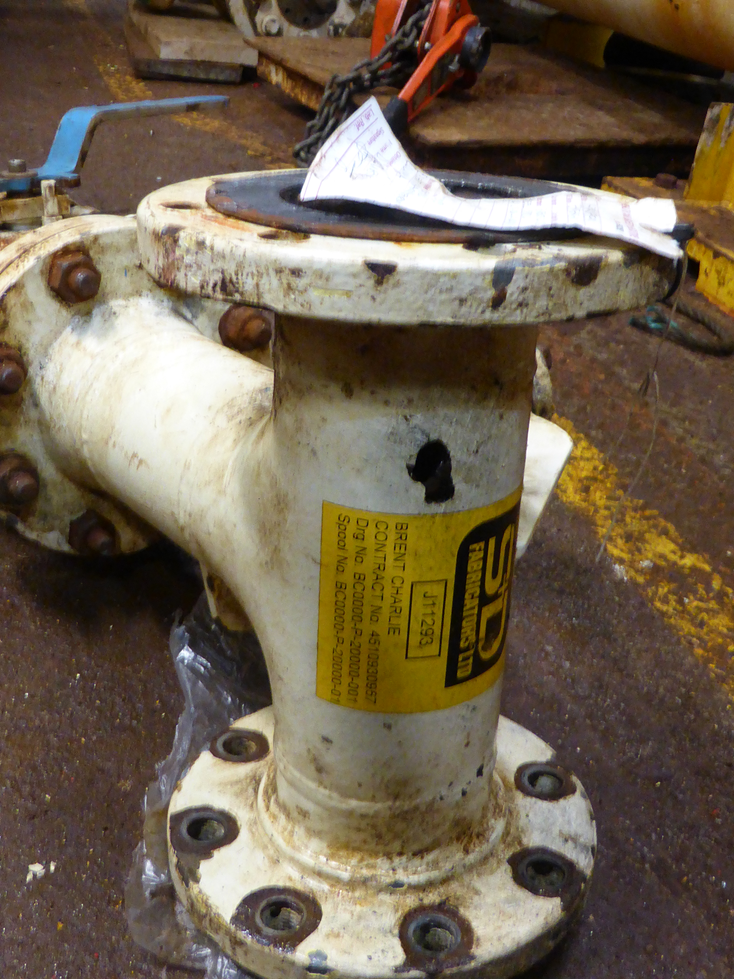
Pipework on Shell UK’s Brent Charlie platform in the North Sea deteriorated to such an extent that contained hydrocarbon fluids escaped, forming a potentially catastrophic explosive and flammable mixture that could have ignited.

In addition to the release, ventilation fans designed to prevent, control or mitigate the effects of escaped hydrocarbon gas did not function properly as they were also not suitably maintained. This led to a large release of mixed phase crude oil and gas from the corroded pipework. The probability of ignition was assessed to be less than 1%. 

Aberdeen Sheriff Court heard on Tuesday 25 November 2025 how, on 19 May 2017, there was an uncontrolled hydrocarbon release incident from a Return Oil Line (ROL) pipework inside concrete leg Column 4 of the Brent Charlie offshore installation. The release involved 200kg of gas and 1,550kg of crude oil – the largest uncontrolled hydrocarbon release on the UK Continental Shelf reported to HSE in 2017.

The release placed over 170 platform personnel at risk from a potentially catastrophic fire and explosion had the escaping hydrocarbon gas ignited inside the concrete leg.

HSE noted that the platform manager, and the various emergency teams, deserve praise for their decision making and actions taken that assisted with preventing the incident from escalating. Their sound judgement and decision making ensured the situation was eventually brought under control.

An HSE investigation found that deficiencies in Shell’s safety management system led to the release. The ROL pipework in Column 4 was not properly maintained for several years. The pipework was installed for short-term use and was due to be removed in 2010 but remained in place for seven years, during which time it suffered corrosion damage. It failed on 19 May 2017 and a large volume of gas was uncontrollably released into the leg. Ventilation extract and supply fans designed to prevent and mitigate this major accident hazard were also inadequately maintained, which exacerbated the risk to the 176 people on the platform.

HSE were involved in the production of the Energy Institute’s Guidance for corrosion management in oil and gas production and processing, as well as several other topic-specific documents. Extensive guidance and resources for the oil and gas industry are available on HSE’s website here Offshore oil and gas – HSE.

Spool with the corrosion failure identified.

Shell UK Limited pleaded guilty to two charges under the Offshore Installations (Prevention of Fire and Explosion, and Emergency Response) Regulations 1995 (PFEER). Sheriff Ian Duguid, in his sentencing remarks, observed that Shell UK “ought to have recognised that the temporary carbon steel spool was not suitable for such a line and should have been replaced.” After considering mitigating factors, Shell was fined £560,000.

Speaking after the hearing, HSE Offshore Health and Safety Inspector Dozie Azubike said: “At more than 1,750kg, Shell Brent Charlie’s hydrocarbon release was the largest reported to HSE in 2017. This release occurred in a confined space with limited access – it is simply fortunate that no one was in the leg at the time, or they could have been asphyxiated from the hydrocarbon-rich atmosphere, quite apart from any fire and explosion risk.

“Although the offshore industry has managed to reduce its overall number of hydrocarbon releases, in most years there are still several which, if ignited, would result in potentially catastrophic consequences.

“This case highlights the importance of oil and gas dutyholders reviewing their current management of change processes for temporary spools and their subsequent removal, strengthening inspection regimes to identify potential internal corrosion within pipework, and ensuring that inspection frequency of safety-critical equipment considers full analysis of the equipment’s maintenance history.”

Further Information:

  1. The Health and Safety Executive (HSE) is Britain’s national regulator for workplace health and safety. We are dedicated to protecting people and places, and helping everyone lead safer and healthier lives.
  2. More information about the legislation referred to in this case is available.
  3. Further details on the latest HSE news releases is available.
  4. Relevant guidance can be found here Offshore oil and gas – HSE
  5. HSE does not pass sentences, set guidelines or collect any fines imposed. Relevant sentencing guidelines must be followed unless the court is satisfied that it would be contrary to the interests of justice to do so. The sentencing guidelines for health and safety offences can be found here.