News

CCTV footage captures harrowing moment worker falls through roof  

Two construction companies have been fined £79,300 after a scaffolder broke his arm, leg and suffered head lacerations after falling through a roof skylight while installing temporary scaffolding edge protection at a warehouse in Yorkshire. 

James Cranswick, 26, was installing temporary scaffolding edge protection for Clover Access Systems Limited at a warehouse at Acre Mills in Keighley, West Yorkshire, when the incident took place. CCTV footage shows Mr Cranswick falling onto a pallet truck before landing on the warehouse floor.  

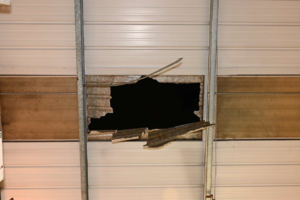
Mr Cranswick was on the roof carrying materials from one end of the unit to the other when he stepped on a skylight and subsequently fell more than 6 metres to the concrete floor beneath.  

An investigation by the Health and Safety Executive (HSE) found that both Clover Access Systems Limited and STM360 Limited failed to plan, manage and monitor the work being undertaken by the scaffolders at the unit. As such, no measures were in place to prevent the scaffolders falling from the edge of the unit, or through the fragile elements of the roof. The skylights of the unit were almost invisible to Mr Cranswick and he was unaware of any fragile elements of the roof.  

Broken roof skylight

HSE guidance details a clear hierarchy for work involving fragile surfaces. Those in control of roof work should firstly avoid the need for access to fragile roofs. Further guidance can be found here: Health and safety in roof work 

Clover Access Systems Limited pleaded guilty to breaching The Construction (Design and Management) Regulations 2015, Regulation 15. They were fined £26,000 and ordered to pay costs of £2,866 at Leeds Magistrates Court on 4 June 2026. The company are now in liquidation. 

STM360 Limited pleaded guilty to breaching The Construction (Design and Management) Regulations 2015, Regulation 13. The company was fined £53,300 and ordered to pay £3,167 in costs. 

HSE Inspector Shauna Halstead, said:  

“Mr Cranswick is lucky to be alive after this incident.  

“His fall was wholly avoidable; the risks associated with work on, or around fragile surfaces are well-known, and HSE guidance is available to assist companies in complying with the law.  

“Everyone working in construction should be aware that HSE will not hesitate to take enforcement action where roof work is not properly managed, as workers should not be needlessly put in harm’s way.  

This HSE prosecution was brought by HSE enforcement lawyer Arfaq Nabi and paralegal officer Hannah Snelling.   

More information:

  1. The Health and Safety Executive (HSE) is Britain’s national regulator for workplace health and safety. We are dedicated to protecting people and places, and helping everyone lead safer and healthier lives.  
  2. More information about the legislation referred to in this case is available. 
  3. Further details on the latest HSE news releases is available.  
  4. Relevant guidance can be found here Health and safety in roof work – HSE 
  5. HSE does not pass sentences, set guidelines or collect any fines imposed. Relevant sentencing guidelines must be followed unless the court is satisfied that it would be contrary to the interests of justice to do so.  The sentencing guidelines for health and safety offences can be found here.   
 

McCain Foods fined after employee loses fingers

A frozen food company has been fined £700,000 after an employee lost two of his fingers following an incident at the firm’s premises in Lincolnshire.

Tom Matthews, from Grantham, now champions health and safety in his current job at a different company, warning others to avoid his misfortune.

He had been working a night shift at McCain Foods’ site in Easton on 2 September 2019 when he suffered serious injuries to his left hand.

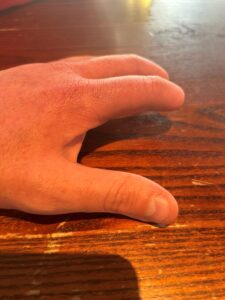
Tom Matthews’ left hand

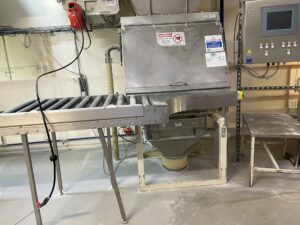
While cleaning the company’s batter system machinery, the 33-year-old had attempted to remove string dangling from a chute when his left hand was drawn in and contacted the machine’s rotary valve.

The index and middle finger were later amputated as a result of the incident.

Tom Matthews, a father-of-two said: “The last four years have been hard and an ongoing struggle both physically and mentally.

“I still have circulation problems in my left hand following the incident that should never have happened.

“While I’m currently working, my new role is with the health and safety team at a different company as I want to use my story as an example to others and make sure something like this doesn’t happen again.”

A Health and Safety Executive (HSE) investigation found that McCain Foods had failed to provide appropriate guarding to prevent access to the dangerous parts of machinery, namely the rotary valve. It had not conducted an adequate risk assessment of the batter machine and had not provided employees with adequate health and safety training or supervision.

HSE guidance can be found at: Provision and Use of Work Equipment Regulations 1998 (PUWER) (hse.gov.uk)

McCain Foods (G.B.) Limited, of Havers Hill, Eastfield, Scarborough, North Yorkshire, pleaded guilty to breaching Section 2(1) of the Health & Safety at Work etc. Act 1974 and Section 11(1) of Provision and Use of Work Equipment Regulations 1998 (PUWER). The company was fined £700,000 and ordered to pay £6,508.51 in costs at Lincoln Magistrates’ Court on 22 November 2023.

HSE inspector Muir Finlay said: “This incident could so easily have been avoided had the company taken simple steps to guard dangerous parts of machinery and provide employees with suitable training and supervision.

“Companies and individuals should be aware that HSE will not hesitate to take appropriate enforcement action against those that fall below the required standards.”

This prosecution was led by HSE enforcement lawyer Jonathan Bambro and supported by Rubina Abdul-Karim.

Notes to Editors:

  1. The Health and Safety Executive (HSE) is Britain’s national regulator for workplace health and safety. We prevent work-related death, injury and ill health through regulatory actions that range from influencing behaviours across whole industry sectors through to targeted interventions on individual businesses. These activities are supported by globally recognised scientific expertise.
  2. More information about the legislation referred to in this case is available.
  3. Further details on the latest HSE news releases is available.

Manufacturing company fined half-a-million pounds after forklift truck death

The mother of a man who was killed when the forklift truck he was driving overturned says she still feels angry as he ‘simply went to work and didn’t come home.’

Jamie Anderson

Jamie Anderson was killed on 4 June 2019, when the forklift truck he was operating overturned at a depot in Newark.

The 35-year-old father of one, was found in the car park trapped under the roll cage of the vehicle. He had been using a counterbalance forklift truck to move waste material when it clipped a kerbstone at the edge of the roadway and overturned. He was not wearing a seatbelt. 

His mum Sarah Anderson, a care assistant from Newark, said: “No mother should lose a child and for Jamie’s son Harley he has lost a loving father.

“As a family we have gone through all emotions, and I still feel angry as Jamie simply went to work and didn’t come home. This should not have happened.

“He was a happy-go-lucky boy and would do anything for anyone. It’s the everyday things that remind me of him and I miss his smile and blue eyes. He’s missed so much.”

An investigation by the Health and Safety Executive (HSE) found that The Barcode Warehouse Ltd failed to enforce the use of seatbelts by forklift truck operators. They should have properly risk assessed the use of forklift trucks on their premises and enforced the use of seatbelts. Instead, it was left to individuals to choose whether to wear a seatbelt or not.

HSE has guidance available on managing forklift trucks.

At Nottingham Magistrates’ Court on 8 November the Barcode Warehouse Ltd of Telford Drive, Newark pleaded guilty to breaching Section 2(1) of the Health & Safety at Work Act 1974.  They were fined £500,000 and agreed to pay costs of £7,039.55.

Speaking after the hearing HSE inspector, Tim Nicholson said: “This tragic incident led to the avoidable death of a young man. Jamie’s death could easily have been prevented if his employer had acted to identify and manage the risks involved and enforced the use of seatbelts by forklift truck operators.”

This HSE prosecution was supported by HSE lawyers Nathan Cook and Jonathan Bambro, and Paralegal Officer Rubina Abdul-Karim.


Notes to Editors:

  1. The Health and Safety Executive (HSE) is Britain’s national regulator for workplace health and safety. We prevent work-related death, injury and ill health through regulatory actions that range from influencing behaviours across whole industry sectors through to targeted interventions on individual businesses. These activities are supported by globally recognised scientific expertise.
  2. More information about the legislation referred to in this case is available.
  3. Further details on the latest HSE news releases is available.

Plant hire company in court over work at height and welfare issues

A plant hire company has been fined for leaving workers at risk of a fall from height and failing to provide minimum welfare facilities.

Blackpool Magistrates’ Court heard how, on 17 November 2020, Ruttle Plant (Birmingham) Ltd was in the process of building a new aggregate recycling facility at their site at Common Bank Lane, Chorley. Part of the work included the provision of cladding to the roof, which was carried out using a cherry picker. However, as some areas of the roof were difficult to reach, employees had to step onto the roof where no edge protection had been provided, putting them at risk of a 30ft fall. In addition, workers had been on site for some considerable time without the minimum required welfare facilities being available. This included facilities for hand washing during the height of the Covid pandemic.

An investigation by the Health and Safety Executive (HSE) found that the workers had been left unsupervised by site management, there had been no method statement to follow when they climbed onto the roof and there were no preventative measures in place to prevent the risk of a fall from height. Workers were also expected to drive to the company’s head office along an unadopted roadway more than five minutes’ drive away to use the toilet, despite there being ample room on the site for facilities.

Ruttle Plant Hire (Birmingham) Ltd of Lancaster House, Ackhurst Road, Chorley, Lancashire pleaded guilty to breaches of Regulation 13(4)(c) of the Construction (Design and Management) Regulations 2015, and Regulation 4(1) of The Work at Height Regulations 2005. The company was fined £66,667 and ordered to pay costs of £1,847.

Speaking after the hearing, HSE inspector Christine McGlynn said: “Had a worker fallen off the roof edge, it could have been fatal. Employers should ensure that workers are not left to carry out high risk roof work without supervision.

“Work at height and roof work should only be carried out by trained workers, who are being robustly monitored, following proper planning, risk assessment and using suitable equipment. The minimum standards for welfare must also be met.”


Notes to Editors:
1. The Health and Safety Executive (HSE) is Britain’s national regulator for workplace health and safety. We prevent work-related death, injury and ill health through regulatory actions that range from influencing behaviours across whole industry sectors through to targeted interventions on individual businesses. These activities are supported by globally recognised scientific expertise. www.hse.gov.uk
2. More about the legislation referred to in this case can be found at: Construction- Roof work industry health and safety 
3. HSE news releases are available at http://press.hse.gov.uk