Press release

Two major companies sentenced over death of man killed by window falling from luxury penthouse

Two companies have been fined a combined £1.3 million after a window unit fell from the 26th floor of a luxury development in London, killing a coach driver on his break as he walked below.

Two of the companies involved in the design of the bespoke windows in the Corniche development on the capital’s Albert Embankment – with one weighing 130kg falling 300 feet to the ground below, killing the 53-year-old father and grandfather instantly.

The incident happened at around 10.30am on 2 October 2018 – Mick had been on a break and was just returning to his coach, which was parked up nearby.

Mick Ferris was killed by the falling window

Mick’s wife Rachel described his death as being ‘so sudden’ and ‘out of the blue

“It has made it so much worse to get used to,” she said.

“Mick was just minding his own business. One minute there, one minute gone.

“The thought this could have happened to anybody is always with me. It could have been a child.

“The fact this could have been prevented, I just can’t explain. If somebody had done something differently – anything – it would have changed our lives.

“I know it wasn’t just one person, but one person could have changed this. One person could have asked ‘can’t we do this better?’.

“What those companies did killed my husband.

“This has changed our lives. It has changed my whole outlook on everything. My life has changed forever.

“We were due to fly to the Maldives the Saturday after Mick died to celebrate our anniversary. We had half-packed suitcases in our house. It was a bucket list place for Mick and he never got to go there. We never got to go there.

“He was also a great dad and grandad – when his kids needed him, he was there.

“He loved driving coaches, having followed in his own Dad’s footsteps as a professional driver.

“Four hundred people attended his funeral – there was even a coach with his name on it. He is missed by so many it is unbelievable.”

St James Group Limited, part of the Berkeley Group, had been the developer of the Corniche, a three tower luxury development near Vauxhall Bridge, as well as the Principal Contractor and Principal Designer.  Lindner Prater Limited was a specialist company engaged by St James to design the penthouse windows.
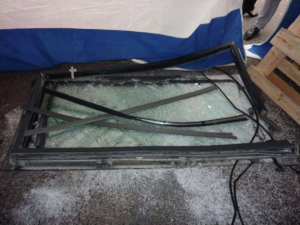
HSE photo taken at scene – showing window pane on ground

A series of failures

At an early stage of the design process, the windows had been changed from opening inwards to opening outwards, meaning if they detached, they would fall onto a pedestrian area.  However, they were never effectively risk assessed.

The safety of the windows relied on the performance of a single restrictor, held in by a single screw, and none of the fittings had been confirmed by their manufacturers to be suitable for the bespoke curved penthouse windows.
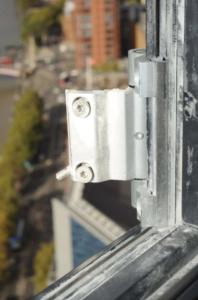
Close up of window frame and bracket taken by police in Oct 2018

In August 2017, more than a year before the fatal incident, a window left open in windy conditions fell from the same penthouses during construction, nearly hitting two workers. St James Limited led an internal review into the 2017 near miss, but records obtained by the HSE showed key noted areas of concern were not followed up effectively.

It was only after the second incident in 2018 and Mr Ferris’ death, that the windows were redesigned to open inward and the public walking below the penthouses were no longer at risk if a window was left open.

Sentence handed down

After a five week trial, both St James Limited, of Berkeley House, 19 Portsmouth Road, Cobham and Lindner Prater Limited of  45 London Road, Reigate, were found guilty found guilty to contravening Section 3(1) of The Health and Safety at Work Act etc. 1974.

At sentencing on 24 September 2026 at the Inner London Crown Court, St James was fined £1million and ordered to pay costs of £125,000 and Lindner Prater Limited was fined £300,000 and ordered to pay costs of £125,000.
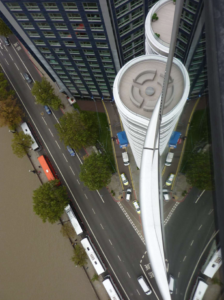
Another taken by HSE showing height of penthouse

HSE lead inspector Andrew Verrall-Withers said:

“Two companies – widely seen as leaders in their fields failed to respond to an obvious risk, and tragically this cost the life of a man simply going about his day.

“Both times a window fell, the wind speeds were not unusually high.”

“Even after a window had fallen in 2017, luckily just missing workers below, sufficient attention was not given to assessing the risk of the windows detaching and falling if left open in windy conditions. Too much reliance was placed on adding a small sign to the windows, in effect hoping the residents would not forget to close windows.”

“The construction industry should pay attention to this tragic case. Principal designers need to pay careful attention to clarifying exactly what services architects, designers, and consultants will provide, and then effectively monitor their performance to ensure related risks are identified and coordinate necessary improvements.

“The investigation assessed the involvement of multiple companies, thousands of documents, and highly complex technical evidence. This was followed by the wait for a Trial.

“We are grateful for Mr Ferris’ family’s understanding throughout and hope this outcome brings them some closure.”

The HSE’s investigation was carried out by HM Inspector Andrew Verrall-Withers and HM Principal Inspector James Goldfinch, and the prosecution brought by Counsel Gordon Menzies and Doug Scott, HSE Senior Enforcement Lawyer James Towey, and paralegal officer Gabrielle O’Sullivan.


Further information:

  1. The Health and Safety Executive (HSE) is Britain’s national regulator for workplace health and safety. We are dedicated to protecting people and places, and helping everyone lead safer and healthier lives.
  2. More information about the legislation referred to in this case is available.
  3. Further details on the latest HSE news releases is available.
  4. HSE does not pass sentences, set guidelines or collect any fines imposed. Relevant sentencing guidelines must be followed unless the court is satisfied that it would be contrary to the interests of justice to do so. The sentencing guidelines for health and safety offences in England and Wales can be found here,
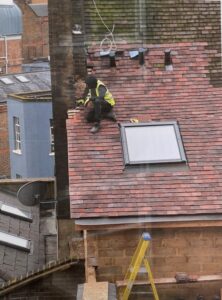
SENTENCED: Construction company and director fined for risking lives with unsafe roof work

A construction company and a director have been fined after workers lives were put at risk with unsafe roof work in central London.

B&O Developers Ltd and Sanjay Swaminaryan were fined following an investigation by Britain’s workplace regulator. The Health and Safety Executive (HSE) took action after members of the public raised concerns about unsafe working practices during extension and refurbishment of what is now the Kings Cross Express Inn on Kings Cross Road.

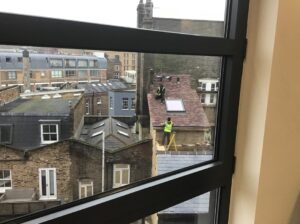
In January 2024, concerned members of the public sent photographs to HSE showing people working on a roof at the site with no control measures to protect them from falling, such as edge protection.

The dangerous and unsafe roof work was spotting by members of the public who sent photographs to HSE

There was no safe means of access to the roof, with operatives photographed standing on a makeshift platform balanced on a stepladder.

The HSE investigation found that there were no controls in place to prevent the workers, who were employed by a subcontractor, from falling from height on at least two separate dates.

Measures which had been identified in the roofing subcontractor’s risk assessment as necessary controls, including scaffolding around the roof, were not in place.

The construction project ran from October 2020 until March 2024 and was initially managed by principal contractor Hubb Construction Ltd, of which Sanjay Swaminarayan, 48, was a director. In March 2023, the principal contractor changed to B&O Developers Ltd, with Mr Swaminarayan retained as the sole director and keeping all other site arrangements the same.

There were no control measures to protect the workers from falling, such as edge protection.

HSE inspectors responded to several concerns raised by the public and occupants of surrounding buildings between November 2021 and September 2023 and took enforcement action against both Hubb Construction Ltd and B&O Developers Ltd.

Inspectors also met with Mr Swaminarayan to discuss how he could improve management arrangements to ensure sustained compliance with health and safety law.

Despite these interventions, a further concern was raised regarding unsafe roof work in January 2024.

Falls from height remain the leading cause of workplace death and injury with the latest statistics from HSE showing that they account for over a quarter of all work related deaths in 2025/26.

HSE guidance states that in order for roof work to be carried out safely there must be, at a minimum, safe access to the roof and a safe place to work on the roof.

For sloping roofs, in practice this usually means providing full edge protection on all roof elevations to which access is needed. Where roofs are steep, the edge protection system needs to be capable of safely containing a person sliding down the sloping surface. Edge protection is also needed at gable ends.

B&O Developers LTD of Prince Albert Road, London, pleaded guilty to breaching Regulation 4(1) of the Work at Height Regulations 2005.  The company was fined £4,020 and a surcharge of £1,608 at City of London Magistrate’s Court on 22 July 2026.

Sanjay Swaminarayan, of St John’s Wood Court, pleaded guilty to breaching Section 33(1)(a) of the Health and Safety at Work (etc) Act 1974 (‘the Act’), by virtue of s37(1) the Act. He was fined £2300, a surcharge of £1,108 and ordered to pay costs of £8,000.

HSE inspector Lucy Ellison-Dunn said:

“The working practices of both the company and Swaminarayan put lives at risk.

“Swaminarayan was fully aware of the requirements for safe work at height, having been given guidance from both HSE and his own health and safety advisors on several occasions.

“Despite repeated assurances to improve work practices, he failed to ensure that suitable controls were in place to prevent falls and did not properly supervise those he employed to manage and carry out the work.

“I would like to thank those concerned members of the public who got in touch with HSE to let us know.

“We will always take action against those that fail to protect the lives of workers.”

The prosecution was brought by HSE enforcement lawyer Colin Bromfield and paralegal officer Thomas Smith.


Further information:

  1. The Health and Safety Executive (HSE) is Britain’s national regulator for workplace health and safety. We are dedicated to protecting people and places, and helping everyone lead safer and healthier lives.
  2. More information about the legislation referred to in this case is available.
  3. Further details on the latest HSE news releases is available.
  4. HSE guidance states what an employer must do to protect their employees from falls from height.
  5. HSE does not pass sentences, set guidelines or collect any fines imposed. Relevant sentencing guidelines must be followed unless the court is satisfied that it would be contrary to the interests of justice to do so. The sentencing guidelines for health and safety offences in England can be found here and those for Scotland here.

Company and director fined after public seriously injured by falling scaffold tower on busy high street

A London construction company and its sole director have been fined after a tower scaffold fell onto two members of the public on a busy high street in south-west London.

On 19 July 2023, operatives working for Add Prop Limited assembled a mobile tower scaffold on Putney High Street while under the supervision of the company’s sole director, Atif Riaz. The scaffold tower, which had been assembled incorrectly with inadequate measures to separate it from members of the public, was subsequently covered in sheeting.

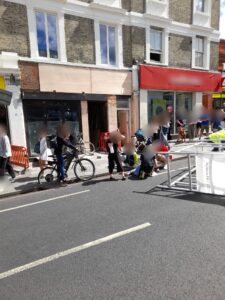
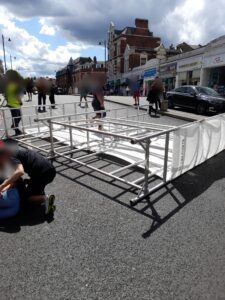
The sheeting acted as a sail in windy conditions, causing the tower scaffold to overturn. The structure struck and trapped two members of the public, resulting in serious injuries.

The scaffold fell onto a busy high street and injured two people

Add Prop Limited was acting as principal contractor on a project to convert a commercial building into residential flats. Mr Riaz was both the project manager and site supervisor and was present overseeing the work on the day of the incident.

An investigation by the Health and Safety Executive (HSE) found that Add Prop Limited had failed to ensure the temporary structure was designed, installed and maintained so that it could withstand foreseeable loads, including those created by wind acting on the sheeting. The company had previously been served with a Prohibition Notice in relation to unsafe work involving a tower scaffold at another site.

The investigation also found that the tower scaffold had neither been assembled nor inspected by adequately trained and competent persons. It had not been erected in accordance with the manufacturer’s instructions or established industry guidance.

The tower scaffold had neither been assembled nor inspected by adequately trained and competent persons

HSE further found that Atif Riaz had been negligent in his role as both sole director and project manager. Despite the well-known risks associated with wind loading on scaffold structures, neither the company nor Mr Riaz took adequate account of those risks before deciding to sheet the scaffold.

HSE guidance states that tower scaffolds must be erected by trained and competent persons and in accordance with manufacturers’ instructions. Dutyholders must also ensure temporary structures are stable and capable of withstanding foreseeable environmental conditions, including wind loading. Further guidance can be found at: Tower scaffolds – HSE.

Following a hearing at Westminster Magistrates’ Court, Add Prop Limited was found guilty of breaching Regulation 19(2)(a) of the Construction (Design and Management) Regulations 2015. The company was fined £20,000 and ordered to pay £7,000 in costs.

Atif Riaz, the company’s sole director, was found guilty of an offence under Section 37 of the Health and Safety at Work etc. Act 1974. He was fined £1,730 and ordered to pay £1,730 in costs.

HSE Inspector Daniel Burton said:

“The public have a right to expect scaffolding they pass by is safe and has been properly installed – yet every year people are injured when scaffold towers overturn.

“In this case, two members of the public suffered serious injuries when a scaffold tower overturned on a busy high street. The risks associated with scaffold towers and wind loading are well known within the construction industry – this kind of incident simply should not happen.

“The fines imposed on Add Prop Limited and Atif Riaz should underline to everyone in the construction industry that the courts, and HSE, take failures to follow health and safety requirements extremely seriously.

“HSE will not hesitate to take action against companies and, where appropriate, directors who fail to do all that they should to keep workers and members of the public safe.”

The HSE prosecution was brought by enforcement lawyer Gemma Zakrzewski and paralegal officer Melissa Wardle.


Further information:

  1. The Health and Safety Executive (HSE) is Britain’s national regulator for workplace health and safety. We are dedicated to protecting people and places, and helping everyone lead safer and healthier lives.
  2. More information about the legislation referred to in this case is available.
  3. Further details on the latest HSE news releases is available.
  4. Relevant guidance can be found here Tower scaffolds – HSE.
  5. HSE does not pass sentences, set guidelines or collect any fines imposed. Relevant sentencing guidelines must be followed unless the court is satisfied that it would be contrary to the interests of justice to do so.  The sentencing guidelines for health and safety offences can be found here.

Two firms fined after worker fractures neck during platform collapse

Two construction companies have been fined after a drilling operative sustained fractures to his neck and back when a temporary platform loaded with concrete debris collapsed on top of him.

Steve Zschoch, now 60, was working for contractors Diacutt Limited on 23 February 2024 at a construction project at Paxton House in the City of London. The refurbishment project, which was being run by principal contractor Roots Contractors Limited, involved cutting openings through five concrete floors to create a service riser shaft.

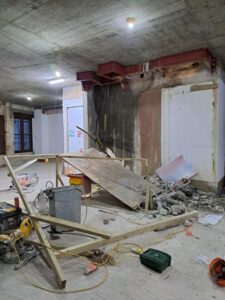
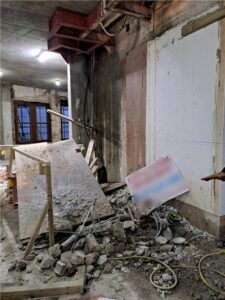
A temporary platform loaded with concrete debris collapsed on top of Steve Zschoch

Roots Contractors Ltd had instructed its carpenters to build temporary wooden platforms under each opening to collect the 16kg concrete cores and debris that were generated by the cutting.

Mr Zschoch had been cutting an opening on the third floor, working directly under one of the temporary platforms, when it suddenly gave way and collapsed on top of him, along with chunks of concrete that had not been cleared away.

He described being “folded up like a concertina.” He sustained injuries including fractures to his neck, his back and a bleed on his brain. He described the profound impact of the incident on his day to day life;

“The impact this incident has had on me has been life changing in so many ways, he said.

“Not just in mobility issues but in my confidence to do just about anything.

“Even simple domestic tasks, like using the launderette or going to the shops can overwhelm me now. Emotionally as well as physically.”

An investigation by the Health and Safety Executive (HSE) found that there was no design for the temporary platforms and no calculation had been made for the safe level of loading.

Steve Zschoch suffered a fractured neck in the incident

While an inspection form for the platform was completed, it failed to identify any issues with the design, and the person tasked to complete it was a not a competent temporary works coordinator.  We also found that although there had been a verbal instruction for workers to regularly clear the platforms of concrete and not ‘overload’ them, no safe level of loading was known, and there was no monitoring of whether the platforms were indeed cleared.

HSE also found deficiencies in the planning, managing and monitoring of the work by the contractor.

Temporary works must be carefully managed. The law says any temporary structure must be designed, installed and maintained to withstand any foreseeable loads which may be imposed on it and that it be only used for the purposes for which it was designed, installed and maintained. They should be inspected by a competent person on a regular basis. Guidance on temporary works is available at hse.gov.uk.

Roots Contractors Limited of Ewell, Surrey, pleaded guilty to breaching The Construction (Design and Management) Regulations 2015, Regulation 16(2). The company was fined £19,333 plus costs of £5,548 at a hearing at Westminster Magistrates’ court on 11 June 2026.

Diacutt Limited of Croydon pleaded guilty to breaching The Construction (Design and Management) Regulations 2015, Regulation 15(2) and was fined £13,000 plus costs of £5,548 at the same hearing.

HSE inspector Lucy Ellison-Dunn said:

“People rightly expect that when they go to work, they are not put in unnecessary danger, and this entirely avoidable incident had the effect of seriously injuring Mr Zschoch and ending his construction career much earlier than he wanted.

“Those providing temporary works have a duty to ensure that any temporary structure is properly designed and constructed to withstand any foreseeable load that might be imposed on it.

“This means having appropriate arrangements in place to manage temporary works.  Contractors should ensure all construction work is properly planned, managed and monitored to ensure workers can carry out their work safely.”

The prosecution was brought by HSE enforcement lawyers Chloe Ward and Jon Mack, supported by Thomas Smith.

Notes to Editors

  1. The Health and Safety Executive (HSE) is Britain’s national regulator for workplace health and safety. We are dedicated to protecting people and places, and helping everyone lead safer and healthier lives.
  2. More information about the legislation referred to in this case is available.
  3. Further details on the latest HSE news releases is available.
  4. Relevant guidance on temporary works is available can be found here and also about the duties of contractors to plan, manage and monitor construction work.
  5. HSE does not pass sentences, set guidelines or collect any fines imposed. Relevant sentencing guidelines must be followed unless the court is satisfied that it would be contrary to the interests of justice to do so.  The sentencing guidelines for health and safety offences can be found here.