Press release

Fine for manufacturing company after man left as ‘a shadow of his former self’

A Staffordshire-based manufacturing company has been fined £300,000 after a family man was left with injuries so serious he became ‘a shadow of his former self’.

Gary Taylor, who was 63 at the time, spent three weeks in hospital and needed seven months off work, following the incident on 24 March 2025.

The grandfather had been working for E H Hassell & Sons Limited at its site on Newstead Ind Estate in Trentham. He was one of several workers involved in the unloading of a lorry trailer containing various steel components for a large filtration system.
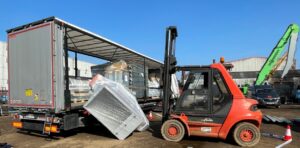
The one-tonne metal hopper slipped from the lorry and struck Gary Taylor on the head

The workers had improvised a system to unload the metal hopper with a forklift truck, placing the forks underneath the unsecured load to lift it from the trailer bed. However, as it slid from the forks, it struck Mr Taylor in the head as he was stood alongside it. His injuries included fractures to his skull, neck and spine, two broken ribs and a severe laceration to his forehead which required 17 staples and 14 stitches.

Mr Taylor described how the incident has had a lasting impact on his life.

“During my time off recuperating from my injuries, the seven months I was off work, I had no interest in anything,” he said.

“I know my wife thinks that I won’t be around with her in my eighties, she has constant worry that something is going to happen to me.

“She never thought like that before my accident.

“For me, I have no idea what the future holds.

“I can only hope that I will get better as time goes on and I become more like the old man I used to be – a supportive husband, father and grandfather to my grandchildren.

“I want to be a person that hopefully will become more of a person than a shadow of my former self.”

An investigation by the Health and Safety Executive (HSE) found that the lifting operation had not been properly planned by a competent person. The characteristics of the load, including its weight, size, centre of gravity and lifting points, had not been adequately assessed, and no safe system of work had been put in place.

Moving an object of this size and weight was not a regular task at the site and there was no established system of work for it.

HSE guidance on Planning and organising lifting operations – HSE states that it is important to properly resource, plan and organise lifting operations so they are carried out in a safe manner.

E H Hassell & Sons Limited of Alderflat Drive, Trentham, Staffordshire pleaded guilty to breaching Regulation 8(1) of the Lifting Operations and Lifting Equipment Regulations 1998 and were fined £300,000 and ordered to pay costs of £5,690 at a hearing at Birmingham Magistrates’ Court on 23 October 2026.

HSE inspector Claire Whitehurst said:

“The failures here resulted in an experienced worker suffering life-changing injuries.

“The company failed to properly plan the lifting operation or implement a safe system of work.

“Mr Taylor suffered serious injuries which could easily have resulted in his death. He has been left with facial scarring, and both he and his family have been deeply affected by this traumatic experience.

“Employers must ensure that lifting operations are properly planned by a competent person and carried out safely. This is especially important for non-routine tasks involving heavy or awkward loads.”

The HSE prosecution was brought by HSE enforcement lawyer, Julian White and supported by HSE paralegal officer, Stephen Grabe. The investigation was supported by visiting officer, Natalka Heath.


Further information:

  1. The Health and Safety Executive (HSE) is Britain’s national regulator for workplace health and safety. We are dedicated to protecting people and places, and helping everyone lead safer and healthier lives.
  2. More information about the legislation referred to in this case is available.
  3. Further details on the latest HSE news releases is available.
  4. Relevant guidance can be found here: Planning and organising lifting operations – HSE
  5. HSE does not pass sentences, set guidelines or collect any fines imposed. Relevant sentencing guidelines must be followed unless the court is satisfied that it would be contrary to the interests of justice to do so. The sentencing guidelines for health and safety offences can be found here.
Half-a-million pound fine for company after worker suffers 40 per cent burns

One of Britain’s leading steel galvanizers has been fined more than £500,000 after one of its workers suffered 40 per cent burns to his body when hit by a wave of molten zinc at its site in Devon.

The employee was working for Wedge Group Galvanizing Limited at its site in Marsh End, Lords Meadow Industrial Estate in Crediton, Mid Devon, when the incident happened on 12 October 2021.

Hot dip galvanizing is a process that provides long-term protection against rust and corrosion of steel products. On the day in question, a lifting chain, carrying a roller steel joist weighing nearly three tonnes, failed. The beam fell into a galvanizing bath and the resulting wave of molten zinc covered the 33-year-old, before hitting a wall and surging back along the floor towards him.

CCTV footage from the scene shows the worker alight and running towards the emergency shower where his clothes were removed and he was doused in water. He was initially treated at the scene by paramedics, before being taken by air ambulance to Southmead hospital in Bristol. He had suffered 40 per cent burns and remained in intensive care for 11 days undergoing 13 separate operations. Any remaining healthy skin was grafted to repair his burnt body.

During his lengthy treatment the man suffered infection and sepsis leaving him with multiple long-term health conditions.

An investigation by the Health and Safety Executive (HSE) found that the set of chains used to lift the heavy steel beam had signs of damage and deterioration and there was a failure to withdraw them. Crucially, the chains had not undergone their mandatory regular inspection.

The investigation also revealed that the load slinging arrangement used at the time of the incident was incorrect, which meant that the load being lifted was greater than the safe limit for the chains. The risk assessment in place at the time of the incident for “immersion & swilling” had no reference to checks on chains, or what type of sling configuration to use.

Wedge Group Galvanizing Limited failed to meet several regulations and standards. Under the Lifting Operations and Lifting Equipment Regulations (LOLER) 1998, lifting accessories must be thoroughly examined by a competent person at least every six months. Both the Lifting Equipment Engineers Association (LEEA) code of practice and the user manual for the chain manufacturer state that chain slings used in acidic environments, such as zinc galvanising, should be inspected before each day’s use.

The Health and Safety Executive publishes freely available guidance which underlines the importance of thorough inspection of lifting equipment, including the benefits of an ‘examination scheme’.

Wedge Group Galvanizing Limited of Stafford Street, Willenhall, West Midlands, pleaded guilty to breaching Section 3(1) of the Health and Safety at Work etc. Act 1974. The company was fined £566,666 and ordered to pay £15,521 in costs at Bristol Magistrates Court on Wednesday 14 October 2026.

HSE inspector Alexander Ashen said:

“This wholly-avoidable incident led to a young man having to endure truly terrible injuries – and the disturbing truth is that the consequences could have been even worse.

“It is shocking that an industry-leading firm,, with considerable resources at its disposal, should risk the lives of its workers with substandard inspection protocols.

“Our thoughts are with the victim at the heart of this incident, his friends and family, and all those at the site who have been affected by what happened that day.”

This HSE prosecution was brought by HSE enforcement lawyer Gemma Zakrzewski, Paralegal Officer, Farhat Basir and Rowena Goodwin, Enforcement Advocate.


Further information:

  1. The Health and Safety Executive (HSE) is Britain’s national regulator for workplace health and safety. We are dedicated to protecting people and places, and helping everyone lead safer and healthier lives.
  2. More information about the legislation referred to in this case is available.
  3. Further details on the latest HSE news releases is available.
  4. Relevant guidance can be found here Planning and organising lifting operations – HSE
  5. HSE does not pass sentences, set guidelines or collect any fines imposed. Relevant sentencing guidelines must be followed unless the court is satisfied that it would be contrary to the interests of justice to do so.  The sentencing guidelines for health and safety offences can be found here.
Electrical wholesaler fined £4million after worker’s crush injuries mean he now needs 24/7 care

A Telford-based electrical wholesaler and manufacturer has been fined £4million after an employee sustained life-changing injuries when he was crushed during loading operations using a forklift truck.

The 40-year-old father of one from Telford was working for City Electrical Factors Limited at its Proteus Switchgear Industrial Division on 4 October 2024 when the incident happened.

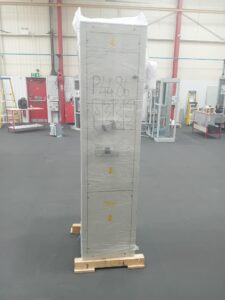
The man had been acting as a “spotter” while a forklift truck loaded heavy switchboard equipment onto a flatbed lorry. The load, which weighed 231kg, was not secured to the forklift and fell on top of him. He sustained brain and spine injuries and underwent lifesaving surgery. However, he can no longer do anything for himself and is unable to communicate with others. As a result of these injuries, he now lives in a care home and requires 24/7 care.

The switchboard equipment weighed more than 200kg

An investigation by the Health and Safety Executive (HSE) found that City Electrical Factors Limited failed to ensure that the lifting operation was properly planned by a competent person, appropriately supervised and carried out in a safe manner. There was no risk assessment or lift plan, and employees had not been provided with information or instructions about the lifting operation, despite this being a regular activity.

The investigation also found that the load could have been secured to the forklift truck using pre-existing anchor points. The load also had lifting eyes welded to it, which meant that the crane attached to the delivery lorry could have been used as a safer alternative to the forklift truck. Instead, employees were appointed as “spotters” and were expected to steady the loads whilst they were being moved and lifted. This was clearly an unsafe and unnecessary system of work.

HSE guidance states that lift plans should address the risks identified by the risk assessment and identify the resources required, the procedures and the responsibilities so that risks are managed, and any lifting operation is carried out safely. You can read more about our guidance here: Planning and organising lifting operations – HSE.

City Electrical Factors Limited pleaded guilty to breaching Section 2(1) of the Health and Safety at Work etc. Act 1974. The company was fined £4m and ordered to pay £6,304 in costs at Birmingham Magistrates Court on 16 October 2026.

HSE inspector Keeley Eves said:

“This incident had truly tragic consequences.

“To make matters worse it was completely avoidable and caused by a failure to properly plan for the job taking place.

“The company could have used safer alternative methods to lift the load, such as the lorry-mounted crane which was available, instead of using the forklift truck.

“Instead, the employee was placed at unnecessary risk and now has to live with his devastating injuries.

“Loading and unloading operations remain one of the most hazardous transport activities in the workplace. Employers must ensure that lifting operations are properly planned by competent persons, supervised and carried out safely.”

This HSE prosecution was brought by HSE enforcement lawyer Julian White and paralegal officer Lynne Thomas, while the investigation was supported by visiting officer Sarah Ough.


Further information:

  1. The Health and Safety Executive (HSE) is Britain’s national regulator for workplace health and safety. We are dedicated to protecting people and places, and helping everyone lead safer and healthier lives.
  2. More information about the legislation referred to in this case is available.
  3. Further details on the latest HSE news releases is available.
  4. Relevant guidance can be found here Planning and organising lifting operations – HSE
  5. HSE does not pass sentences, set guidelines or collect any fines imposed. Relevant sentencing guidelines must be followed unless the court is satisfied that it would be contrary to the interests of justice to do so.  The sentencing guidelines for health and safety offences can be found here.

Fencing company fined after employee fell from a ladder

A fencing and land services company in Ripon has been fined after an employee suffered spinal fractures when he fell from a ladder during the erection of an acoustic fence.

The 23-year-old man was working for Metcalfe Fencing Contractors Ltd at a site in North Tyneside on the 10 of December 2024. He had been erecting a four metre tall, 265 metre long section of acoustic fencing in between the busy A19, near Holystone, and a housing estate.

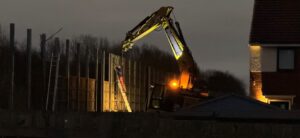
The work was planned in such a way that required the use of a ladder on uneven, muddy ground, and an excavator was used to lift the fence panels over the head of the operator situated on the ladder. However, the slings of the excavator became tangled in the ladder during this operation, causing the ladder to tip, and the employee to fall approximately two metres onto the ground.

The man fell from a ladder while erected an acoustic fence

An investigation by the Health and Safety Executive (HSE) found that Metcalfe Fencing Contractors Limited failed to properly plan the lifting operation and the work at height activities.

Falls from height remain the leading cause of workplace death and injury and HSE guidance states that employers must ensure lifting operations and work at height activities are properly planned, and that they are carried out in a way which is, so far as is reasonably practicable, safe. This includes making decisions about whether the work at height can be eliminated entirely. You can read more about our guidance here – Work at height – HSE.

Metcalfe Fencing Contractors Ltd, of The Annexe Heatherlands, Grantley, Ripon, pleaded guilty to breaching Section 2(1) of the Health and Safety at Work etc. Act 1974. The company was fined £22,000 and ordered to pay £5,327 in costs at South Tyneside Magistrates Court on 29 September 2026.

HSE inspector Matthew Dundas said:

“Every year, a significant proportion of accidents, many of them serious and sometimes fatal, occur as a result of poorly planned lifting operations or work at height activities.

“This particular incident was wholly avoidable. Had the company used reasonable practicable measures such as remote release clamps on the lifting equipment, and tag-lines to avoid the need to work on a ladder, this injury would not have occurred.”

This HSE prosecution was brought by HSE enforcement lawyer Iain Jordan and paralegal officer Zara Salman.


Further information:

  1. The Health and Safety Executive (HSE) is Britain’s national regulator for workplace health and safety. We are dedicated to protecting people and places, and helping everyone lead safer and healthier lives.
  2. More information about the legislation referred to in this case is available.
  3. Further details on the latest HSE news releases is available.
  4. HSE guidance on working at height is available.
  5. HSE does not pass sentences, set guidelines or collect any fines imposed. Relevant sentencing guidelines must be followed unless the court is satisfied that it would be contrary to the interests of justice to do so.  The sentencing guidelines for health and safety offences can be found here.