Press release

Six-figure fine for fish processing company after supervisor suffered life-threatening injuries

A fish processing company has been fined £451,500 after a supervisor suffered multiple fractures and two collapsed lungs when he became entangled in a palletiser machine at its Lerwick plant.

Pelagia Shetland Limited, of Point of Scattland, Gremista, Lerwick, pleaded guilty to health and safety failings following the incident.

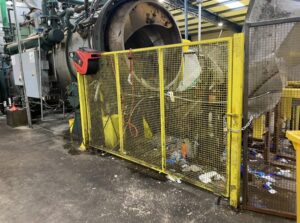
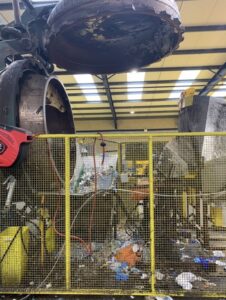
On 10 October 2024, Curtis New, a 41-year-old forklift supervisor was called to clear a blockage and, finding an interlocking safety gate difficult to open, removed a panel and entered the machine area. As he walked along the stationary conveyor to reach the blockage, he triggered a sensor which restarted the machine, and he was struck repeatedly by its pushers before a colleague hit an emergency stop button.

Mr New was treated at the scene by first aiders before being airlifted to Aberdeen Royal Infirmary, where he spent 10 days in intensive care and a further 10 days in a high dependency unit. He suffered eight fractured ribs, a pelvis fractured in five places, a fractured clavicle and scapula, and two collapsed lungs. He was later transferred to Gilbert Bain Hospital for rehabilitation, and has since said he does not wish to return to his role.

An investigation by Health and Safety Executive (HSE) inspectors found that perimeter safety fencing around the machine, designed to isolate its power supply whenever the interlocking safety gate was opened, had become insecure after a panel was damaged.

The gate had been struck by a forklift truck in early 2024, damaging its locking mechanism and making it difficult to open. Rather than use the gate, two senior staff, including Mr New, had taken to removing the loose panel to clear frequent blockages in the machine, without isolating the power first.

Pelagia Shetland reported the incident to HSE on the day it happened and following an investigation, the company reinstated its perimeter fencing so that the gate is now the only means of accessing the machine. They also updated safety practices to make clear that staff must never bypass safety barriers, on pain of disciplinary action.

Pelagia Shetland Limited, of Point of Scattland, Gremista, Lerwick, pleaded guilty to breaching Regulations 11 (1) and (2) of The Provision and Use of Work Equipment Regulations 1998, section 33(1)(c) of the Health and Safety at Work etc. Act 1974. The company was fined £420,000 and must pay a victim surcharge of £31,500 at Lerwick Sheriff Court on 26 August 2026.

HSE inspector Matty Spiers said:

“This was a wholly avoidable incident that left a man with life-threatening injuries, and it happened because a basic, well-understood safety control was allowed to fail.

“Interlocking guards exist for one reason: to stop people reaching dangerous machinery while it’s still live. When that gate was damaged, it should have been repaired properly and its integrity restored immediately, not left in a state where a determined employee could simply lift out a panel and walk into a hazardous area.

“Curtis New is fortunate to be alive. He suffered catastrophic injuries carrying out a task that should never have been possible without the machine being isolated first.

“Employers have a legal duty to make sure guarding and interlock systems are properly maintained, and that any weakness is identified and corrected without delay. This isn’t a bureaucratic box-ticking exercise, it’s what stands between a workforce and a serious, life-changing injury.”

Further information:

  1. The Health and Safety Executive (HSE) is Britain’s national regulator for workplace health and safety. We are dedicated to protecting people and places, and helping everyone lead safer and healthier lives.
  2. More information about the legislation referred to in this case is available.
  3. Further details on the latest HSE news releases is available.
  4. HSE does not pass sentences, set guidelines or collect any fines imposed. Relevant sentencing guidelines must be followed unless the court is satisfied that it would be contrary to the interests of justice to do so.  The sentencing guidelines for health and safety offences in Scotland can be found here.
Manufacturing company fined after worker fractures twelve ribs in pillar drill incident

A spring and stampings manufacturing company has been fined £40,000 after an employee fractured twelve ribs during a lifting operation in Worcestershire.

The 36-year-old employee suffered multiple rib fractures while working at The Micro Spring and Presswork Company Limited when the incident occurred on 24 June 2024.

He had been assisting with the lifting of a newly purchased pillar drill using a forklift truck at the company’s site on Enfield Industrial Estate, Redditch.

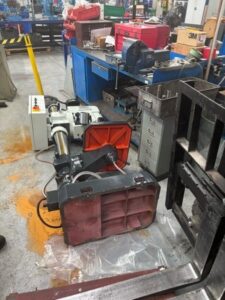
The pillar drill, which weighed approximately 500kg, became unstable during the operation and fell, striking the employee and causing serious injuries.

Pillar drill

An investigation by the Health and Safety Executive (HSE) found that Micro Spring and Presswork Company Limited had failed to undertake a suitable and sufficient assessment of the risks associated with the lifting operation.

The investigation also found that the company had failed to ensure the lifting operation was properly planned by a competent person, appropriately supervised and carried out in a safe manner.

HSE has produced an approved code of practice and guidance for employers, duty holders and anyone with responsibility for controlling lifting equipment.

Micro Spring and Presswork Company Limited, of Enfield Industrial Estate, Redditch, Worcestershire, pleaded guilty to breaching Section 2(1) of the Health and Safety at Work etc. Act 1974. The company was fined £40,000 and ordered to pay £5032 in costs at Kidderminster Magistrates’ Court on 25 August 2026.

HSE inspector Charlie Rowe said:

“This was a serious incident which has resulted in significant injury and was entirely preventable.

“Employers should always ensure lifting operations are properly planned by a competent person, appropriately supervised, and carried out in a safe manner. This firm’s failure to do so has had dramatic consequences.

“HSE has produced a wealth of guidance to assist employers in keeping people safe, but where companies fall short we will not hesitate to take action.”

The prosecution was brought by HSE enforcement lawyer Julian White and supported by paralegal officer Farhat Basir.

Six-figure fine for ExxonMobil after five leaks of extremely flammable hydrocarbons at Fife chemical plant

ExxonMobil Chemical Limited has been fined £267,000 after health and safety inspectors found corroded pipes had resulted in five leaks of flammable gas at its Fife Ethylene Plant.

An investigation by Health & Safety Executive (HSE) inspectors found the company’s arrangements for inspection of insulated pipework were not adequate and resulted in five known leaks of extremely flammable hydrocarbons at the natural gas processing plant operated by the company at Mossmorran, near Kirkcaldy.

The plant was an Upper Tier COMAH [Control of Major Accident Hazards] establishment as defined by the 2015 COMAH Regulations, due to the volume of hazardous substances on site and the risk to people and the environment they presented. This means it was subject to the strictest controls because of the potential for catastrophic consequences of health and safety failings.

How the leaks were discovered

On 21 May 2019, Health and Safety Executive (HSE) inspectors visited the site for a routine inspection. They noticed a strong smell of Dimethyl Sulphide (DMS), a highly flammable liquid that irritates eyes and skin and is harmful if swallowed. An operator confirmed that DMS and ethane were leaking from an overhead pipe, and that the company had known about the leak for around four months but had kept operating without taking extra precautions.


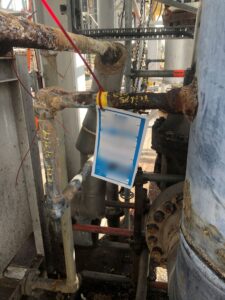
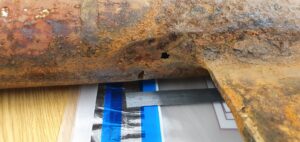
Two holes can be seen in the affected part of the pipe

HSE launched an investigation. This revealed that the leak was not a one-off. There had been an earlier leak on the same pipe in February 2018, and another on a different pipe elsewhere on site in December 2018, both caused by Corrosion Under Insulation (CUI). As the investigation progressed, two more leaks were discovered, meaning five leaks in total, all caused by CUI. The investigation broadened to examine how the company managed CUI risk across the site.

The five leaks

23 February 2018: A pinhole leak of DMS and ethane developed on a 2-inch steel pipe (the “DMS line”), which was under high pressure and running at 115 degrees Celsius. The leak went on for around four months before being fixed.

15 December 2018: A leak of ethane gas was spotted by chance on a different pipe (the “ST01 Overheads line”) when a worker noticed a haze coming through the insulation while doing unrelated work. Corroded cladding had let four small holes form. The leak lasted around six weeks and an estimated 82 tonnes of hydrocarbons escaped into the atmosphere.

21 May 2019: The leak that triggered HSE’s routine inspection was found on the same DMS line as before, but at a different point. This time the leak was a mix of 20% DMS and 80% ethane. The company had first detected it on 29 January 2019, meaning it had been leaking for about four and a half months. HSE issued a Prohibition Notice on 24 May 2019 banning access to the area, followed by an Improvement Notice on 28 May 2019 ordering repairs. The company fixed the problem on 13 June 2019 by installing a bypass.

26 June 2019: While HSE’s investigation was still underway, a process technician found another pinhole leak, this time on the inlet line to the acetylene converter. X-ray testing showed the pipe had corroded below its safe minimum thickness. The company shut down part of the plant to make repairs, and the leak lasted around two weeks. Unlike the earlier leaks, this time the company acted swiftly rather than continuing to operate without extra safeguards.

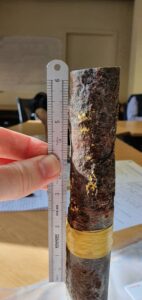
A straight ruler can be seen placed against the pipe, demonstrating extensive corrosion around the area of the leak

September 2019: While carrying out inspections required by HSE’s Improvement Notice, the company found a further pinhole leak on the ST01 Overheads line, close to the site of the December 2018 leak. This was repaired by purging the line and applying an epoxy wrap.

Why this matters

Every leak released highly flammable hydrocarbons into the atmosphere. In all but one case, this happened while the plant was operating normally, with staff and contractors working on site.

Pipes on sites like this are often insulated to stop them freezing. Corrosion Under Insulation happens when water gets in under that insulation and corrodes the pipe underneath. Left unchecked, it weakens pipes until they fail and leak. The industry accepts that CUI can’t be prevented entirely where insulation is needed, but it must be properly monitored and managed to keep the risk under control.

The company required to shut part of the plant down in order to effect a repair after a pinhole leak was identified on a one-inch small bore connection

HSE’s investigation found the company’s inspection system was not fit for purpose. Inspectors carried out visual “scoping” checks on each pipe, and the results were fed into a computer tool alongside data on the pipe and its operating conditions. This produced a risk score from 1 (high risk) to 4 (low risk), and the company would only investigate further if a pipe scored 1 or 2.

In practice, these visual inspections were often inadequate. Overhead pipes were typically checked from ground level, sometimes several metres away, with limited visibility, and insulation was not always removed to allow a proper look underneath. Despite suffering repeated leaks caused by CUI, the company did not recognise that its inspection process was flawed until HSE took enforcement action.

Exxonmobil Chemical Limited, of Fawley Administration Building, Fawley Refinery, Marsh Lane, Southampton, pleaded guilty to breaching Regulation 6(2) of The Provision and Use of Work Equipment Regulations 1998, and section 33(1)(c) of the Health and Safety at Work etc Act 1974. The company was fined £267,000 at Kirkcaldy Sheriff Court on 25 August 2026.

HSE inspector Lindsey Stein said:

“At a site run by one of the biggest energy companies in the world, subject to the strictest controls, and processing high volumes of hazardous material, what our inspectors found beggars belief.

“The failure of ExxonMobil to properly inspect insulated pipework led to five separate leaks of highly flammable hydrocarbons, and while none of these leaks resulted in a catastrophic event, this was down to good fortune rather than good management. The arrangements in place to detect and prevent corrosion were woefully inadequate, and the consequences could have been far more serious.

“Systematic risk management isn’t just best practice, it’s a legal duty, precisely because these are high-hazard operations where the margin for error is minimal. In its simplest terms, process safety is about keeping hazardous substances where they belong: inside the pipes, not in the atmosphere.

“Once we stepped in, the operator was able to identify and fix problems quickly and effectively. That tells you everything you need to know: the measures needed to prevent these leaks were reasonably practicable all along, and they should have been in place long before HSE was forced to intervene.”


Further information:

  1. The Health and Safety Executive (HSE) is Britain’s national regulator for workplace health and safety. We are dedicated to protecting people and places, and helping everyone lead safer and healthier lives.
  2. More information about the legislation referred to in this case is available.
  3. Further details on the latest HSE news releases is available.
  4. HSE does not pass sentences, set guidelines or collect any fines imposed. Relevant sentencing guidelines must be followed unless the court is satisfied that it would be contrary to the interests of justice to do so.  The sentencing guidelines for health and safety offences in Scotland can be found here.
Cornwall sawmill and company director fined after failing to act on health and safety notices

A Cornwall-based timber company and its director have been handed a £20,000 fine after failing to comply with a series of enforcement notices issued by health and safety inspectors.

Truro Sawmills Limited and its Managing Director, Alistair Wright, have been fined after failing to comply with improvement notices served by the HSE.

Truro Sawmills Limited supplies timber and manufactures gates, fencing panels and garden furniture, processed at its sawmill in Penhallow, Truro. The company was served with Improvement Notices after HSE inspectors found that employees were not being protected from the ill health risks arising from wood dust, nor the safety risks associated with the use of rider-operated lift trucks in the workplace. If not properly controlled, wood dust can cause asthma, respiratory conditions and cancer.

The HSE investigation found that employees had not been appropriately trained to use rider-operated lift trucks. Staff had also not been face fit tested for respiratory protective equipment (RPE) to protect them from wood dust and were not under suitable health surveillance.

An investigation by the HSE determined that Truro Sawmills Limited had failed to comply with its legal duty under Section 2(1) of the Health and Safety at Work etc. Act 1974 and had contravened the requirements of three Improvement Notices served by HSE to protect its workers.

Alistair Wright, the company’s Managing Director, also pleaded guilty to contravening the requirements of an Improvement Notice. HSE applied for Mr Wright to be disqualified from acting as a company director under the Company Directors Disqualification Act 1986.

Relevant guidance on the use of rider-operated lift trucks and the control of wood dust can be found here:

Lift-truck training – HSE

Wood dust – HSE

Fit testing basics – HSE

Health surveillance – HSE

Truro Sawmills Limited, of Penhallow, Truro, TR4 9NF, pleaded guilty to four counts, including breaching Section 2(1) of the Health and Safety at Work etc. Act 1974 and contravening the requirements imposed by three Improvement Notices, contrary to Section 33(1)(g) of the Act.

Alistair Wright, Managing Director of Truro Sawmills Limited, pleaded guilty to one count of contravening a requirement imposed by an Improvement Notice, contrary to Section 33(1)(g) and Section 37(1) of the Act.

The company was fined £20,000 and ordered to pay £5,000 in costs. Mr Wright was fined £5,000 and ordered to pay £2,500 in costs, at a hearing at Truro Crown Court on 20 August 2026. The court granted HSE’s application to disqualify Mr Wright from acting as a company director for a period of five years.

HSE principal inspector Melissa Lai-Hung said:

“Exposure to wood dust can cause asthma, respiratory conditions and cancer – yet this firm failed to act on legally-binding notices served by health and safety inspectors to protect their workforce.

“We also found workers hadn’t been properly trained to use lift trucks, creating very real dangers for those onsite.

“Firms should be left in no doubt that companies and individuals who do not comply with health and safety legislation will be held accountable.”

This HSE prosecution was brought by HSE enforcement lawyer Robert James and paralegal officer Mike Millman.


Further information:

  1. The Health and Safety Executive (HSE) is Britain’s national regulator for workplace health and safety. We are dedicated to protecting people and places, and helping everyone lead safer and healthier lives.
  2. More information about the legislation referred to in this case is available.
  3. Further details on the latest HSE news releases is available.
  4. Relevant guidance on use of FLTs and control of wood dust can be found here: Lift-truck training – HSE,  Wood dust – HSE, Fit testing basics – HSE and Health surveillance – HSE.
  5. HSE does not pass sentences, set guidelines or collect any fines imposed. Relevant sentencing guidelines must be followed unless the court is satisfied that it would be contrary to the interests of justice to do so.  The sentencing guidelines for health and safety offences can be found here.

Surgeons spend six hours saving worker’s arm after it was severed below elbow in machinery incident

A clinical waste disposal company has been fined £300,000 after one of its workers severed his arm from the elbow down while unblocking machinery in Swindon.

The man – who was 42 at the time – had been working his usual night shift at Tradebe Healthcare National Limited’s site on Elgin Industrial Estate on 4 February 2022. He had been working alongside a colleague when he attempted to clear an obstruction on an autoclave machine. His left arm was trapped and crushed by the door – severing it from the elbow down.

The man had been unblocking this machine when the incident happened

He was rushed to hospital where doctors spent six hours saving his arm. He has since had three major surgeries to restore the use of his hand, though he now suffers from very limited movement.

Part of his treatment has involved skin grafts taken from the thigh of his left leg as well as veins from his left and right legs transplanted into the arm. He still suffers from constant pain and struggles to complete many everyday tasks independently.

Autoclave machines are pressure vessels with lids or doors and are used in a variety of processes whereby products are placed inside and subjected to greater than atmospheric pressure and elevated temperatures. A rotoclave is a type of autoclave that rotates during operation. On this particular site, it was used for high temperature sterilisation of waste.

HSE’s investigation found multiple failings by the company including exposing workers to risk

The machine was surrounded by an enclosure which included an access gate at its rear. The man had used this unsecured rear gate to walk into the enclosure to reach in to remove the debris. His colleague was unable to see the employee and due to miscommunication, mistakenly resumed operation of the machine.

An investigation by the Health and Safety Executive (HSE) revealed multiple failings by the company, including:

The investigation also found that training provided to employees was inadequate and that employees were not suitably supervised.

HSE guidance highlights the importance of following safe isolation and lock-off procedures before any maintenance or cleaning work is carried out. Employers must ensure all machinery is properly isolated from power sources, and that systems are regularly monitored and reviewed to prevent inadvertent start-up. Further guidance is available here: The safe isolation of plant and equipment – HSE.

Tradebe Healthcare National Limited of Atlas House Third Avenue, Globe Park, Marlow, Buckinghamshire, pleaded guilty to breaching Section 2(1) of the Health and Safety at Work etc. Act 1974. The company was fined £300,000 and ordered to pay costs of £18,710.

HSE inspector Emma Preston said:

“This was a harrowing incident made more tragic by the fact that events of this kind are all-too foreseeable.

“Accidents which happen when cleaning and maintaining machinery often result in life-changing injuries, which is why companies need to make sure they have robust lock-off procedures, effective guarding, and that all sources of power are fully isolated before work begins.

“The man affected by this incident faces a long road to recovery and we hope today’s outcome provides him a measure of justice.”

This prosecution was brought by HSE enforcement lawyer Chloe Ward and supported by paralegal officer Farhat Basir.


Further information:

  1. The Health and Safety Executive (HSE) is Britain’s national regulator for workplace health and safety. We are dedicated to protecting people and places, and helping everyone lead safer and healthier lives.
  2. More information about the legislation referred to in this case is available.
  3. Further details on the latest HSE news releases is available.
  4. Relevant guidance can be found here – Using work equipment safely – HSE and Safe use of work equipment – HSE.
  5. HSE does not pass sentences, set guidelines or collect any fines imposed. Relevant sentencing guidelines must be followed unless the court is satisfied that it would be contrary to the interests of justice to do so.  The sentencing guidelines for health and safety offences can be found here.

Waste and recycling company fined £400,000 after woman crushed

An Essex-based waste and recycling company has been fined £400,000 after an employee was seriously injured after being struck by a mobile shredder at its site in Basildon.

Clearaway Recycling Limited, based at Archers Fields, was sentenced after a 22-year-old site operative was crushed by the moving vehicle while accessing the tipping yard on 28 October 2024. She suffered life-threatening injuries when she was trapped between a gate post and the shredder itself. She has been left with life-changing injuries as a result of the incident.

The woman was crushed between this mobile shredder machine and a gate post

An investigation by the Health and Safety Executive (HSE) found the company had not managed the movement of pedestrians and vehicles at the site. This allowed it to become custom and practice for pedestrians to walk in areas close to moving vehicles, including the shredder, as well as close to lorries and forklift trucks.

The waste and recycling industry saw six workers killed during 2025/26 – which when compared over a five-year period, means fatalities are ten times as likely compared to the all-industry average.

Clearaway Recycling Limited of Archers Fields, Basildon, pleaded guilty to breaching Section 2(1) of the Health and Safety at Work Act 1974. The company was fined £400,000 and ordered to pay costs of £10,259 at Chelmsford Magistrates’ Court on 13 August 2026.

HSE inspector Joanne Williams said:

“The waste and recycling sector continues to be one of the leading industries for workplace injuries and fatalities.

“One of the reasons is the risks from vehicle and pedestrian collisions are well known, yet serious incidents continue to occur.

“In this case, a young woman was left with significant and life-changing injuries.

“Where pedestrians require access to working areas, safeguards must be in place to protect them, including providing adequate segregation or separation distances between pedestrians and vehicles in the area.”

The case was taken by HSE enforcement lawyer Andrew Siddall, supported by paralegal officer Thomas Smith.


Further information:

  1. The Health and Safety Executive (HSE) is Britain’s national regulator for workplace health and safety. We are dedicated to protecting people and places, and helping everyone lead safer and healthier lives.
  2. More information about the legislation referred to in this case is available.
  3. Further details on the latest HSE news releases is available.
  4. Guidance is available here – https://www.hse.gov.uk/pubns/indg199.htm, https://www.wishforum.org.uk/wp-content/uploads/2019/06/WASTE-09-.pdf and https://www.hse.gov.uk/roadsafety/worker/index.htm.
  5. HSE does not pass sentences, set guidelines or collect any fines imposed. Relevant sentencing guidelines must be followed unless the court is satisfied that it would be contrary to the interests of justice to do so.  The sentencing guidelines for health and safety offences in England

SENTENCED: Construction company and director fined for risking lives with unsafe roof work

A construction company and a director have been fined after workers lives were put at risk with unsafe roof work in central London.

B&O Developers Ltd and Sanjay Swaminaryan were fined following an investigation by Britain’s workplace regulator. The Health and Safety Executive (HSE) took action after members of the public raised concerns about unsafe working practices during extension and refurbishment of what is now the Kings Cross Express Inn on Kings Cross Road.

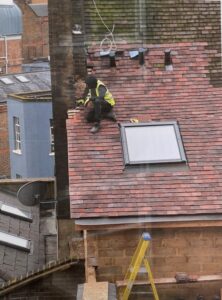
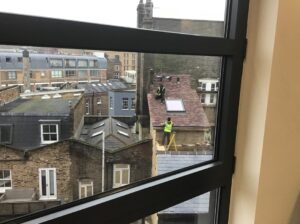
In January 2024, concerned members of the public sent photographs to HSE showing people working on a roof at the site with no control measures to protect them from falling, such as edge protection.

The dangerous and unsafe roof work was spotting by members of the public who sent photographs to HSE

There was no safe means of access to the roof, with operatives photographed standing on a makeshift platform balanced on a stepladder.

The HSE investigation found that there were no controls in place to prevent the workers, who were employed by a subcontractor, from falling from height on at least two separate dates.

Measures which had been identified in the roofing subcontractor’s risk assessment as necessary controls, including scaffolding around the roof, were not in place.

The construction project ran from October 2020 until March 2024 and was initially managed by principal contractor Hubb Construction Ltd, of which Sanjay Swaminarayan, 48, was a director. In March 2023, the principal contractor changed to B&O Developers Ltd, with Mr Swaminarayan retained as the sole director and keeping all other site arrangements the same.

There were no control measures to protect the workers from falling, such as edge protection.

HSE inspectors responded to several concerns raised by the public and occupants of surrounding buildings between November 2021 and September 2023 and took enforcement action against both Hubb Construction Ltd and B&O Developers Ltd.

Inspectors also met with Mr Swaminarayan to discuss how he could improve management arrangements to ensure sustained compliance with health and safety law.

Despite these interventions, a further concern was raised regarding unsafe roof work in January 2024.

Falls from height remain the leading cause of workplace death and injury with the latest statistics from HSE showing that they account for over a quarter of all work related deaths in 2025/26.

HSE guidance states that in order for roof work to be carried out safely there must be, at a minimum, safe access to the roof and a safe place to work on the roof.

For sloping roofs, in practice this usually means providing full edge protection on all roof elevations to which access is needed. Where roofs are steep, the edge protection system needs to be capable of safely containing a person sliding down the sloping surface. Edge protection is also needed at gable ends.

B&O Developers LTD of Prince Albert Road, London, pleaded guilty to breaching Regulation 4(1) of the Work at Height Regulations 2005.  The company was fined £4,020 and a surcharge of £1,608 at City of London Magistrate’s Court on 22 July 2026.

Sanjay Swaminarayan, of St John’s Wood Court, pleaded guilty to breaching Section 33(1)(a) of the Health and Safety at Work (etc) Act 1974 (‘the Act’), by virtue of s37(1) the Act. He was fined £2300, a surcharge of £1,108 and ordered to pay costs of £8,000.

HSE inspector Lucy Ellison-Dunn said:

“The working practices of both the company and Swaminarayan put lives at risk.

“Swaminarayan was fully aware of the requirements for safe work at height, having been given guidance from both HSE and his own health and safety advisors on several occasions.

“Despite repeated assurances to improve work practices, he failed to ensure that suitable controls were in place to prevent falls and did not properly supervise those he employed to manage and carry out the work.

“I would like to thank those concerned members of the public who got in touch with HSE to let us know.

“We will always take action against those that fail to protect the lives of workers.”

The prosecution was brought by HSE enforcement lawyer Colin Bromfield and paralegal officer Thomas Smith.


Further information:

  1. The Health and Safety Executive (HSE) is Britain’s national regulator for workplace health and safety. We are dedicated to protecting people and places, and helping everyone lead safer and healthier lives.
  2. More information about the legislation referred to in this case is available.
  3. Further details on the latest HSE news releases is available.
  4. HSE guidance states what an employer must do to protect their employees from falls from height.
  5. HSE does not pass sentences, set guidelines or collect any fines imposed. Relevant sentencing guidelines must be followed unless the court is satisfied that it would be contrary to the interests of justice to do so. The sentencing guidelines for health and safety offences in England can be found here and those for Scotland here.

Telehandler driver sentenced over death of colleague

A self-employed telehandler driver has been sentenced after he reversed over his colleague on a construction site in Cheshire, causing fatal injuries.

In June 2023, 49-year-old James Connolly was working as a lift supervisor on a large construction site in Ince, Ellesmere Port, where Michael Nixon was working as a telehandler operator.

James Connolly

On the morning of 11 June, whilst walking back to his work area from the welfare compound, Mr Connolly was struck and reversed over by the telehandler being operated by Michael Nixon, resulting in fatal injuries.

In a victim personal statement, Jamie’s mother Pauline Connolly said:

“I have constant flashbacks to that day and every time we get a phone call my heart drops and I fear the worst news, I am always saying, ‘who is it? What is it?’

“Every time I see someone in a high viz jacket and a hard hat, I think it is Jamie. I am changed forever since my son’s death. I miss and think about him every day. My first-born child. My only son.”

Jamie’s daughter Amelia Connolly said:

“I struggle with a great deal of anger. I am angry that my dad went to work and never came home. Alongside the sadness there is also a constant sense of injustice. It is difficult to accept that someone could leave home for work and never return to their family.”

An investigation by the Health and Safety Executive found that the principal contractor had taken steps to minimise the need for reversing on site, including the creation of a turning circle, which was unobstructed at the time of the incident. Despite this, Michael Nixon, who was a qualified and experienced telehandler operator, chose to reverse the vehicle without the aid of a banksman, with tragic consequences.

The investigation also found that Michael Nixon had been using his mobile phone whilst in control of the telehandler, contrary to the site rules he had signed up to.

HSE publication The safe use of vehicles on construction sites HSG144 sets out the risks involved and ways of avoiding reversing on construction sites, as well as setting out a checklist of safe working practices for drivers to follow.

Michael Nixon, 46, of Deeside, Heswall, Wirral, pleaded guilty to breaching Section 3(2) of the Health and Safety at Work etc. Act 1974.

He was sentenced to 12 weeks’ imprisonment, suspended for 12 months, and fined £800. He was also ordered to pay £2,000 in costs, at Warrington Magistrates’ Court on 11 August 2026.

HSE Principal Inspector Laura Royales said:

“Workplace transport incidents remain one of the biggest causes of deaths in the workplace. It is vital that drivers follow the site rules and do not cut corners and put lives at risk.

“Our thoughts remain with the family of James Connolly.”

This HSE prosecution was brought by HSE enforcement lawyer Nathan Cook and paralegal officer Benjamin Stobbart. The investigation was supported by Visiting Officer Sarah Ough.


Further information:

  1. The Health and Safety Executive (HSE) is Britain’s national regulator for workplace health and safety. We are dedicated to protecting people and places, and helping everyone lead safer and healthier lives.
  2. More information about the legislation referred to in this case is available.
  3. Further details on the latest HSE news releases is available.
  4. Relevant guidance can be found here The safe use of vehicles on construction sites HSG144
  5. HSE does not pass sentences, set guidelines or collect any fines imposed. Relevant sentencing guidelines must be followed unless the court is satisfied that it would be contrary to the interests of justice to do so.  The sentencing guidelines for health and safety offences can be found here.

Bricklayer hospitalised for a month after fall through collapsing roof

Bricklayer hospitalised for a month after fall through collapsing roof

An Oldham-based construction company has been fined after a bricklayer was hospitalised for a month when the floor he was working on collapsed.

On 4 June 2024 at a house under construction on Lynn Street, Oldham, the 25-year-old was bricklaying on the upper level of a house when the floor he was working on collapsed.

The worker fell along with multiple concrete blocks that had been stored on the upper floor. He sustained fractures to his right leg, hip and left hand, requiring surgery and a month-long stay in hospital.

Concrete blocks that had been stored on the upper floor

An investigation by the Health and Safety Executive (HSE) found that Oldham Business and Construction Management Limited, as the principal contractor, had failed to properly plan, manage and monitor the construction work on site.

The floor that collapsed had been overloaded with concrete blocks and had not been constructed in accordance with the manufacturer’s design.

The investigation also identified a number of other health and safety failings at the site, including unsafe scaffolding, inadequate arrangements for work at height, a lack of fire alarms and inadequate competent site management.

As a result of these failings, HSE inspectors issued multiple enforcement notices.

HSE guidance states that effective management of health and safety is crucial to the successful delivery of a construction project. Principal contractors have an important role in managing the risks associated with construction work and must plan, manage and monitor the construction phase, ensuring that effective preventative and protective measures are in place and that appropriate supervision is provided.

HSE has a range of guidance on managing health and safety in construction available online.

Oldham Business and Construction Management Limited, of Bath Street, Oldham, pleaded guilty to breaching Regulation 13(1) of the Construction (Design and Management) Regulations 2015. The company was fined £30,000 and ordered to pay £4,883 in costs, to be paid within 3 years, at Warrington Magistrates’ Court on 11 August 2026.

HSE Inspector Karen Farley said:

“The injuries suffered by this worker were the consequence of fundamental failures to manage health and safety.

“Our investigation revealed that this was not an isolated failing but part of a broader pattern of poor health and safety standards across the site.

“The construction industry remains one of the highest-risk sectors and employers must ensure that work is properly planned, supervised and carried out safely.

“This incident was entirely foreseeable and could have been prevented had the floor been constructed in accordance with the manufacturer’s instructions and safe systems of work been in place to ensure it was not overloaded with construction materials.”

The HSE prosecution was brought by HSE Enforcement Lawyer Arfaq Nabi and Paralegal Officer Hannah Snelling.

Further Information

  1. The Health and Safety Executive (HSE) is Britain’s national regulator for workplace health and safety. We are dedicated to protecting people and places, and helping everyone lead safer and healthier lives.
  2. More information about the legislation referred to in this case is available.
  3. Further details on the latest HSE news releases are available.
  4. HSE does not pass sentences, set guidelines or collect any fines imposed. Relevant sentencing guidelines must be followed unless the court is satisfied that it would be contrary to the interests of justice to do so. The sentencing guidelines for health and safety offences can be found here.

Building company and director fined after botched extension put family’s lives at risk

A Yorkshire-based building company and its director have been sentenced after botched building work on a home extension compromised gas safety and put the lives of a homeowner and her two children at risk.

Adam’s Building Construction Ltd had been hired by the homeowner to build an extension at the rear of her property in Bradford. Construction began in January 2024, but the extension was built over the top of the existing gas service pipework, and without repositioning the flue serving the property’s gas boiler. This exposed the family to the risk of gas leaks, fire, explosion and carbon monoxide poisoning.

An investigation by the Health and Safety Executive (HSE) found that on 22 May 2024, a Building Control Inspector from the City of Bradford Metropolitan Council attended the property and discovered that the boiler flue was terminating inside the extension. He contacted Northern Gas Networks, who found the gas installation to be immediately dangerous, with the boiler still in operation and the flue discharging into the extension. The gas supply had to be cut off, leaving the residents without gas for several weeks and costing them around £4,000 to put right.

The investigation also found that Adam’s Building Construction Ltd had been warned several times by local authority Building Control Inspectors during the works that the gas pipework and flue needed to be properly relocated. The company’s sole director, Mohammed Adam Azhar, was unable to show HSE inspectors that his company had prepared construction phase plans for any of its building work, which was carried out exclusively for domestic clients.

This led HSE to serve an Improvement Notice requiring the company to put in place a system for producing written construction phase plans for projects where it was the principal contractor. The company subsequently failed to comply with that notice, an offence under Section 33(1)(g) of the Health and Safety at Work etc. Act 1974. Mr Azhar also personally failed to provide relevant information to the investigation when required to do so by the HSE Lead Inspector, an offence under Section 33(1)(e) of the Act. The court heard that neither the company nor Mr Azhar continue to work in the construction trade.

Adam’s Building Construction Ltd, of Leeds Road, Bradford, pleaded guilty to breaching Section 3(1) and Section 33(1)(g) of the Act. On 7 August 2026 at Leeds Magistrates Court, the company was fined a total of £10,000 and ordered to pay costs of £4,263.

Mohammed Adam Azhar, of Intake Road, Bradford, pleaded guilty to breaching Section 37(1) and Section 33(1)(e) of the Act. He was fined a total of £1,000 and ordered to pay a victim surcharge of £400.

HSE Inspector David Beaton said:

“This was a tragic accident waiting to happen. The failure on the part of the company and its director to properly plan this building work, and to make suitable arrangements for relocating the gas pipework and appliances, could have easily had fatal consequences for the family living in the property.

“Those failures were compounded by the further failures to comply with an HSE Improvement Notice, and to provide relevant information to assist our investigation.

“Everyone in control of domestic building work must ensure that a suitable and sufficient construction phase plan is in place before building work commences, so that no-one faces the kind of risks this family were exposed to.”

This Prosecution was brought by HSE Enforcement Lawyer Arfaq Nabi and supported by Paralegal Officer Henrietta Ruthven.


Further information:

  1. The Health and Safety Executive (HSE) is Britain’s national regulator for workplace health and safety. We are dedicated to protecting people and places, and helping everyone lead safer and healthier lives.
  2. More information about the legislation referred to in this case is available.
  3. Further details on the latest HSE news releases are available.
  4. Guidance on Construction Phase Plans, including a template, can be found in HSE publication CIS80, freely downloadable at https://www.hse.gov.uk/pubns/cis80.pdf.
  5. HSE does not pass sentences, set guidelines or collect any fines imposed. Relevant sentencing guidelines must be followed unless the court is satisfied that it would be contrary to the interests of justice to do so. The sentencing guidelines for health and safety offences in England and Wales can be found here.