- Two decades after one of Europe’s largest industrial incidents, the legacy of Buncefield continues to shape safety standards across the UK’s major hazards sector
This week marks 20 years since the Buncefield explosion in Hertfordshire – one of the largest industrial incidents in Europe and the UK’s largest peacetime explosion.
The incident
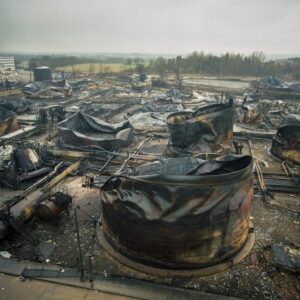
In the early hours of 11 December 2005, a storage tank at the Buncefield oil storage depot overfilled, releasing a massive petrol vapour cloud that spread beyond the site perimeter and ignited. The resulting explosions and fires caused widespread damage and disruption, forcing thousands of residents and businesses to evacuate.
Remarkably, no lives were lost. However, the impact on people, property and the environment was profound. More than 2,000 homes and 600 businesses were affected, with damage extending several kilometres beyond the site. The incident left a lasting mark on the local community and fundamentally changed the UK’s approach to managing major hazard risks.
Investigation and accountability
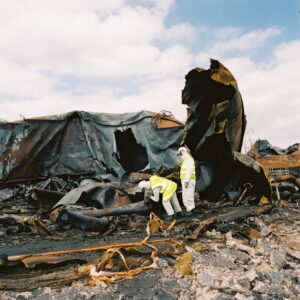
The Health and Safety Executive (HSE) and the Environment Agency (EA) jointly led one of the most extensive industrial investigations in UK history. The work involved detailed forensic analysis, engineering assessments and consultation with industry experts to determine how the incident occurred and what could be learned.
The investigation identified systematic failings in tank level monitoring, overfill prevention and safety management systems. Weak oversight and inadequate controls allowed large quantities of petrol to overflow undetected, leading to the release of a vapour cloud that ignited with catastrophic force.
Following the investigation, the operating companies and site owners were successfully prosecuted under the Health and Safety at Work Act. The courts imposed multi-million-pound fines, setting a precedent for accountability in major hazard industries. The case outcomes reinforced the responsibility of operators to maintain robust systems for preventing and mitigating major accidents and the importance of Process Safety Leadership.
Learning and reform
In the aftermath of the incident, several major reviews and task groups were established to drive improvements:
- The Buncefield Standards Task Group (BSTG) – a joint regulator-industry initiative – developed stronger standards for fuel storage and transfer operations
- The Major Incident Investigation Board (MIIB) published a series of influential reports identifying root causes and recommending wide-ranging reforms to safety leadership, management systems and emergency planning
- The Process Safety Leadership Group (PSLG) was created to oversee implementation, producing its 2009 final report which set out new benchmarks for overfill prevention, automatic shutdown, secondary containment and process safety management.
Onshore major hazard industries have recently relaunched the Process Safety Leadership Principles Guidance taking the important opportunity this anniversary offers to promote good practice.
These reports provided a foundation for industry-wide reform, promoting stronger leadership, real-time monitoring, improved reliability of electrical and control systems, and closer collaboration between regulators and operators.
Sarah Albon, Chief Executive of the Health and Safety Executive, said:
“Twenty years on from Buncefield, we remember not only the scale of the incident but also the determination shown by everyone involved to learn from what happened and drive lasting change.
“The comprehensive investigations, reforms to safety standards, and strengthened collaboration between regulators and industry have created a legacy that continues to protect people and places today. Buncefield demonstrated that when we face serious challenges head-on with transparency and commitment to improvement, we can fundamentally change how major hazards are managed.
“As HSE, we remain committed to applying these lessons, working closely with industry and our regulatory partners to ensure the highest standards of safety and environmental protection across all major hazard sites in Great Britain.”
Legacy and ongoing impact
Two decades on, Buncefield remains a defining moment in UK major hazards safety regulation. The incident exposed critical weaknesses in risk management and highlighted the importance of learning, transparency and continuous improvement in the robust oversight of major hazard sites.
Since then, HSE and the EA have worked with industry and international partners to strengthen safety standards, enhance risk management and ensure consistent enforcement where failings occur.
The lessons of Buncefield continue to shape not only how onshore major hazard industry operates, but how HSE itself develops as a regulator. Investing in people, building capability and fostering a culture of learning remain central to HSE’s mission.
Ken Rivers, Board Member for Health and Safety Executive said:
“Buncefield has led to profound changes not just in the operational, technical and regulatory aspects of managing major hazards but also in leadership, and the way industry and regulator work together in the UK.
“It led industry to becoming more self-disciplined, taking ownership, and it led to a more mature and collaborative relationship with the regulator.
“The impact of Buncefield remains with us today continuing to stimulate industry and regulator to work together to protect people and places.”
The Buncefield anniversary is an important reminder that vigilance, leadership, continuous learning and robust regulation are essential to protecting people, communities and the environment.
Notes to editors:
- The Health and Safety Executive (HSE) is Britain’s national regulator for workplace health and safety. We are dedicated to protecting people and places, and helping everyone lead safer and healthier lives.
- Buncefield section on our website: Buncefield – HSE
- Process Safety Leadership Group (PSLG) guidance: Buncefield Response Programme